Ask which roof lasts longest and you will usually hear the name of a material. Slate and clay come out well on paper, and so does zinc. That answer is fair but incomplete, because a covering is only as durable as the way it is held down and the way its joints are sealed. A slate roof with rusted fixings fails long before the slate does, and a tile roof clipped for sheltered inland conditions may not suit a sea gale.
Roofs along the Sussex coast take wind, driving rain and salt. This page looks at those three in turn: how wind loads are worked out and why fixing standards matter, the extra care that applies near Shoreham airport, what manufacturers actually say about salt air, and the typical lifespans published for each covering. Where no clear rule exists, the maker's data sheet and a survey of your own roof are what to follow.
If your question is simply which covering lasts longest when you replace a roof, our guide to the longest-lasting roof takes that on directly. For the wider picture of what we do across Worthing and the coast, see our home page.
Wind is the main test for a seaside roof
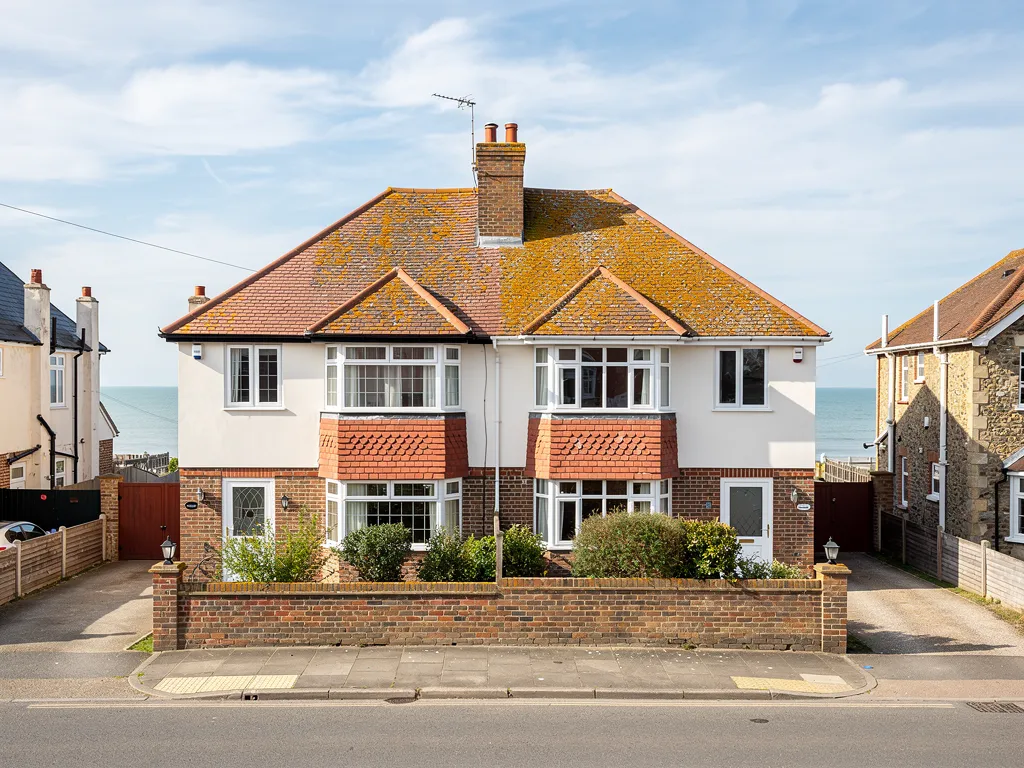
A gale lifts a roof more than it presses on one. Air speeding over a slope drops the pressure on top of the covering, and the windward side suffers most. Marley notes that below 30° of pitch that side can see severe suction. Low-pitched roofs, which are common on 1930s semis with shallow hips and on post-war bungalows, therefore need their fixings thought through with particular care.
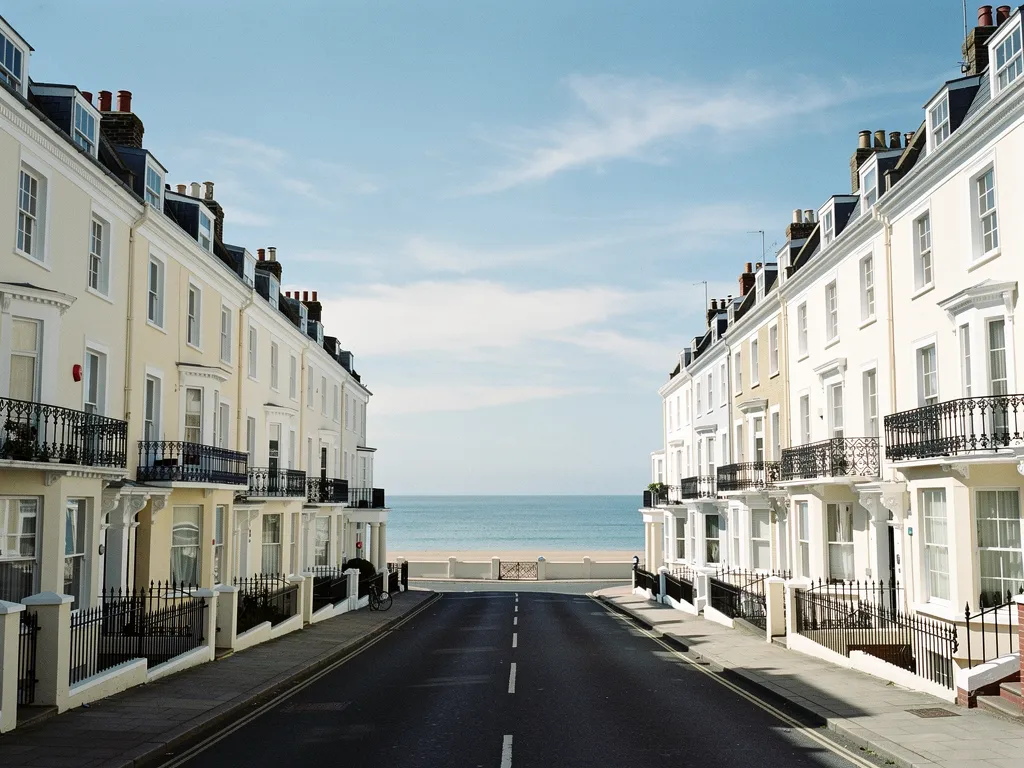
Wind loads come from calculation, not guesswork. Marley points designers to the Eurocode method, BS EN 1991-1-4, which begins with the wind speed assumed for the location and then allows for the lie of the land, the terrain around it and the size of the building. Two houses a mile apart can legitimately need different fixing schedules, because an open seafront terrace and a sheltered street behind it do not meet the same wind.
Why fixings are specified site by site
A rule of thumb sometimes places a whole stretch of coast in one band. Applying that to a named Sussex town would be guesswork, so we leave it alone. Marley asks for the manufacturer to confirm a tile's suitability where a slope runs longer than 6 metres, or where the site is rated as heavily exposed under the driving-rain guidance.
What this means for you is practical. A roofer who says the same fixings suit every house on the coast has not looked at your site. A good one asks the height of the building, the length of the slope, the pitch and the surroundings, then works from the manufacturer's guidance. Our spoke on tile fixing in coastal wind goes through the questions in more depth.
BS 5534 and how tiles and slates are held on
BS 5534 sets out how slates and tiles should be laid and held down. It was revised in 2014 and amended in 2015 and 2018. Marley describes the change plainly: mortar's grip alone stopped being trusted for ridge and hip tiles, so every bedded tile or fitting now gets a mechanical fixing too. That covers hip irons, clips, screws and the like, depending on the product. Earlier practice accepted a mortar bed by itself.
Compliance with the standard is not a legal requirement, Marley adds. It is, however, the recognised benchmark, and a roofer who works to it is working to the yardstick a surveyor, an insurer or a building control officer would use. The ridge shows why. A mortar bed alone can crack and let go, while a clip or screw keeps the tile on the roof after the bed has failed.
Single-lap tiles and the perimeter
Wienerberger's guidance is that each single-lap tile takes at least one mechanical fixing, and that the schedule is written for the site, allowing for its location, altitude and how exposed it is. Marley adds that tiles around the perimeter, the most vulnerable part, were to be fixed twice.
Dry-fix ridges and verges
Dry-fix systems replace mortar with clips, screws and ventilated sections. BS 8612:2018 is the specification that tests them. A dry ridge also removes the repointing that a mortar bed asks for every few years. Slate has a rule of its own: Cupa Pizarras advises against slate hooks on pitches below 25°.
Fixing detail is covered on our pages for slate fixing on exposed roofs and ridge tile repairs.
Near Shoreham airport: a local fixing question
Part of our area lies close to an airfield, and that can change the wind a roof meets. Aircraft leave vortices behind them as they take off and land. Marley warns that roofs close to an airport can feel local wind forces beyond what the BS 5534 calculation gives, and it refers designers to Digest 467 from the Building Research Establishment.
Marley's technical team asks to be consulted on the fixing specification for any site within 6km of an airport. Shoreham airport stands on reclaimed land beside Old Shoreham, which can bring some Shoreham, Lancing and Sompting addresses into range. We do not name distances for individual streets, because the real test is the measured distance from the airfield to your own roof and the manufacturer's answer.
What to do if you are near the airfield
Close to the airfield, ask the tile maker whether the fixing schedule needs special advice, and ask your roofer to confirm that this has been checked. It is a simple question, and the reply shows whether the site has been thought about or a standard schedule has been pulled off the shelf.
It is not a reason to worry about a roof that is already in place, and nothing here suggests that roofs near the airport are failing. It is a point for the specification stage of a new roof, a re-cover or a large repair, when fixings are chosen. Keep the confirmation with your written quote, since it records what the roof was designed for.
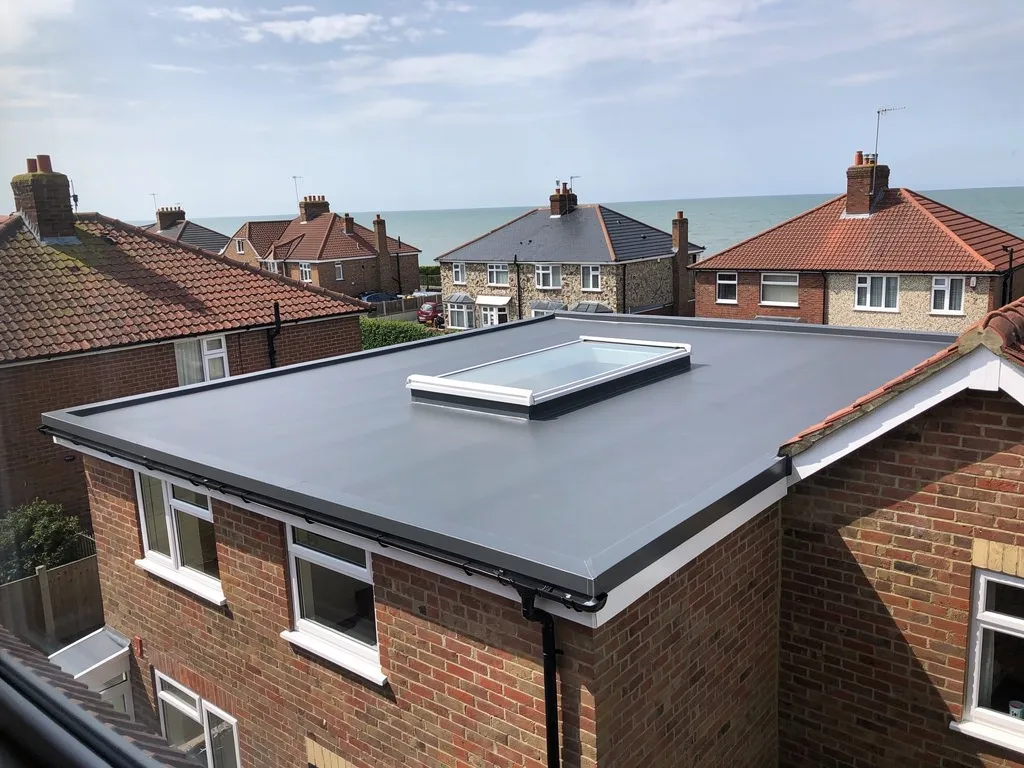
The point holds for flat roofs too, where membranes and their fixings resist uplift. Our page on flat roof wind uplift explains how those are held down.
Salt air: what is known about metals and the roofline
Salt is the part of coastal weather that owners worry about most, and the published evidence is narrower than the folklore. What manufacturers actually say concerns zinc and the painted or plastic parts of the roofline.
Zinc
A zinc maker's FAQ says the metal does well beside the sea and its usual warranties apply there, but that salt-laden air can react with it. It sorts sites into three bands by distance from the shore: up to 1 km is the most punishing band, 1 to 3 km the next, and 3 to 20 km shows low maritime influence. White marks appear mostly where rain never rinses the surface, under overhangs for instance, and rinsing with clean water about twice a year keeps salt in check. Within 1 km, pre-weathered finishes can still stain permanently.
Soffits and fascias
HomeBuilding agrees that marine air can stain and corrode some metal surfaces, and adds that boards beneath the eaves collect salt that the rain never reaches. Plain rinsing, a sound paint film and a seasonal look are what the evidence supports. If the boards are painted timber, check that the film has not cracked, because salt and moisture then work into the bare wood.
Fixings and flashings
For nails, clips and lead near the sea, follow what the covering maker specifies for the product and the site, and ask your roofer to show you that specification. A confident answer names the fixing, who set it and where it is written down.
Our page on the roofline in salt air looks at fascias, soffits and gutters in more detail.
Typical lifespans by covering
Lifespans are published as ranges, and they depend on exposure, workmanship and maintenance. None is a promise, and a manufacturer's warranty is a different thing from a service life. Treat the table as a comparison, not a forecast for your roof, and read each figure with the covering's age and condition in mind.
| Covering | Typical life, as published | Source |
|---|---|---|
| Natural slate | 80 to 100 years or more | MyBuilder |
| Clay tile | A minimum of 60 years | Marley |
| Concrete tile | Often 30 to 60 years | Marley and MyBuilder |
| Lead flashing | Over 80 years | MyJobQuote |
| Zinc | 60 to 100 years or more | Zinc maker and HomeBuilding |
| EPDM flat roof | 20 to 30 years or more | GreenSpec and CORC |
Slate and clay lead on paper, and the figures show why people value them. Concrete tile sits lower but still reaches decades. Lead flashing is quoted at over 80 years, and over 100 for higher codes, which are the thicker sheets. Flat membranes live shorter lives: Less puts GRP at 25 to 40 years and torch-on felt at 10 to 20 years, while MyBuilder gives 15 to 30 years for flat roofs overall. On the roofline, MyBuilder reckons fascias and soffits come off every 10 to 20 years.
These numbers describe typical conditions. A covering that is badly fixed or never looked at will sit at the lower end of its range or below it. Cost differs too: MyBuilder gives £100 to £180 per m² for slate, and our costs page shows the lower per-square-metre figures for flat roofing. Access and the shape of the roof move both figures, as does anything the survey turns up.

Choosing a covering and checking the roofer
With the figures in hand, the choice usually comes down to what suits the building, the budget and the planning position. A Victorian terrace in a conservation area may need slate to match, while a post-war bungalow can take clay or concrete tiles. A heavier covering may need a structural check: the Planning Portal treats a new covering that is 15 per cent or more heavier as a trigger for building control approval.
On the coast, the questions below matter as much as the covering. They also help you weigh up quotes, because a written price should name the covering and the fixing method.
- Which covering is proposed, and what pitch does it need?
- How will tiles, ridges and verges be fixed, and to which standard?
- Has the fixing specification been checked for the site, and for the airport if you are near it?
- What underlay, battens and flashings does the job include?
- Is VAT included, and is scaffolding?
Who to ask
Our guides on how to find a good roofer and the questions to ask a roofer help with the conversation. Once the roof is on, the seasonal roof maintenance checklist keeps it in order, and a rinse of the soffits and a clear gutter do more for a coastal roof than most owners expect.
Our survey produces photographs of your roof and one written total, with the salt-exposed edges, ridge and flashings looked at first. If the quote names a covering, a fixing method and a standard, you have what you need to compare it with any other.