A poor roofing job often starts with a rushed hiring decision, made while water drips through the ceiling and the nearest phone number is to hand. A little order at the start protects the roof and your money. The steps below follow the sequence a careful homeowner would use, from deciding what is wrong to knowing what you are entitled to once the paperwork is signed.
Roofing is difficult to judge from the ground. You cannot see the lead behind a chimney or the condition of the underlay from the pavement, so in practice you are judging how a firm behaves: if the roofer actually climbs up and looks, if you are shown what was found, and if the paperwork says plainly what you are buying. None of that needs any roofing knowledge.
This guide covers the whole journey for a house in Worthing or the towns around it, and it comes from Watertight Worthing Roofing, so it also says how we work. The warning signs of a rogue trader have their own page, how to tell a dodgy roofer, and the list of things to ask at the survey is in questions to ask a roofer.
Pin down the job before you phone anyone
Firms can only quote sensibly for a job that has been described sensibly, so start with what you actually know. Write down where the water shows, when it appears and which way the rain was blowing. Photograph any ceiling stain, slipped tile or sagging gutter you can spot from outside, and note the age of the roof if you know it. Our guide to roofing jobs explained sets out the kinds of work there are, so you can tell if the question is a repair, a re-cover, a flat roof, lead or the roofline.
Repair, or something bigger
Do not settle the answer in advance. A single slipped tile and a worn-out underlay can look identical from a bedroom window. Ask every firm to say which it is, and why, and treat any firm that jumps to a full new roof without showing you evidence with caution. MyBuilder (updated 21/08/2026) gives a typical UK range for a roof repair of £150 to £1,500, while its new-roof guide runs from £5,000 to £12,000 depending on house type. The distance between those two figures is the reason the diagnosis matters.
When the leak will not wait
If water is coming in now, ask for the opening to be made safe first and the proper repair planned for dry weather. A sensible firm will agree, and the bigger decision can then be made calmly. Ask what was done on the day to stop the water, and get it noted in writing so the later quote starts from a known position.
Build a shortlist of firms you can check
Start with people you know. A neighbour whose roof matches yours, a letting agent or a surveyor who has seen the work afterwards will tell you more than a search page. A firm based near you is also easier to call back and has to live with its name locally, which is the argument set out in our note on why a local roofer matters.
Then look for things you can verify. A named business with an address you can look up, a phone number that gets answered, and photographs of finished work on roofs like yours. A Victorian slate terrace near the seafront and a 1930s tiled semi at Goring need different skills, and a firm should be able to show it has handled yours. The number of quotes worth collecting is a question of its own.
Reading reviews with care
Fake consumer reviews, and reviews that conceal an incentive, have counted as unfair in all circumstances since 6 April 2025, under paragraph 13 of Schedule 20 to the DMCC Act 2024. That makes them unlawful, but it does not make them easy to spot, so read for detail. A useful review names the job, describes the roof and says how a problem was handled. A run of near-identical one-line praise posted close together deserves a second look, and a score on its own says little.
The firm that finds you
Someone who knocks on the door to say they have noticed loose tiles has chosen you, not the other way round. Thank them, take no decision on the doorstep, and put any genuine concern through the same shortlist as everyone else.
Judge the survey visit, not just the price
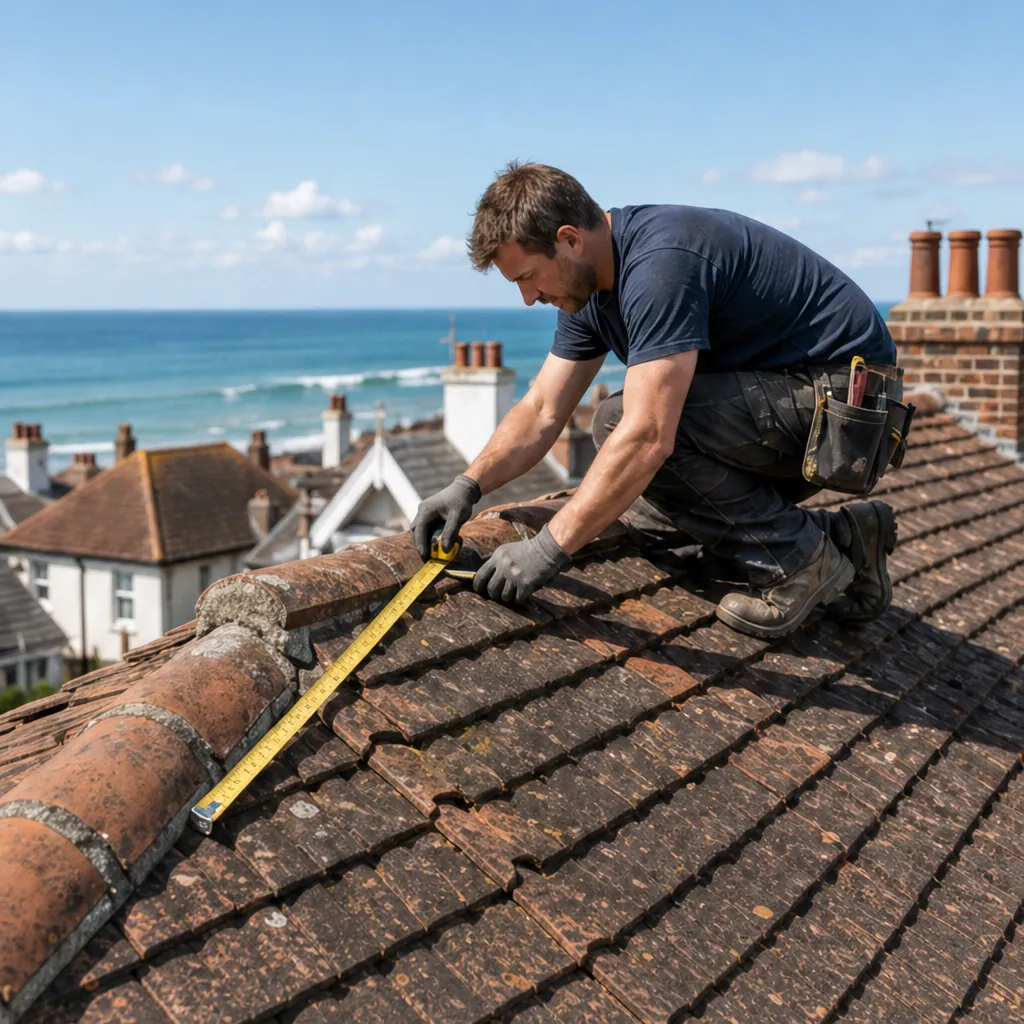
A proper survey is the clearest sign of a good roofer, because it is where the diagnosis happens. The firm should look at the roof from outside, using a ladder, and on high or awkward roofs a drone or a pole-mounted camera, and should usually look in the loft too. Water seldom enters where the stain shows. It travels down the underlay (the waterproof sheet laid under tiles or slates) and drops at the nearest gap, so the cause is often a flashing, a valley or a ridge well away from the mark on the ceiling.
Ask to see what was found. Pictures of the fault on your house, taken that day and sent with the quote, let you check the claim against the problem rather than trust a description. Be wary of anyone who looks only from the pavement and then names a price, and equally of anyone who offers a pile of generic pictures that could belong to any house. Never climb up to look yourself.
Fixing for the coast
Sea gales test every shortcut, so ask how ridges and verges will be held. Ridge and hip tiles have needed a mechanical fixing alongside any mortar since the 2014 revision of BS 5534, so ask the roofer what actually holds yours down. Our guide to roofs on the Sussex coast explains why exposure matters.
A survey on its own
If you want an independent report, for a house purchase or a disputed cause, a standalone roof inspection is a separate job. MyBuilder (updated 21/08/2026) gives a typical UK range of £150 to £250 for a standard inspection, and the report is yours to keep whichever firm you choose.
Read the written quote as one total price
Insist on the quote in writing. A figure given on the doorstep or over the phone is not something you can hold anyone to. The document should carry your address, a plain description of the work and the covering to be used, the total price, and a start period. It should also say whether VAT is included and whether the scaffold is part of the price, because both can change the figure by a large amount. MyBuilder (updated 21/08/2026) quotes around £850 to £1,200 as the usual UK cost of scaffolding a two-storey house.
Compare quotes on what they cover, not only on the final figure. A lower total may simply be a smaller job: a patch where another firm proposes a re-cover, a cheaper covering, or no scaffold. Ask each firm what its price assumes, and ask yourself whether the work described is the work you need.
Why two totals differ
Access, the covering, the roof's size and whatever the survey uncovers each shift the total. A bungalow with a hipped roof, for instance, can be cheaper to reach than a three-storey terrace on a narrow street, even when the area to cover is similar. Third-party guides are a useful check on the order of magnitude. A semi-detached re-roof with a gable end runs from £5,000 to £8,000 in MyBuilder's guide, and from £8,000 to £12,000 with hips.
The best protection is not a haggled number. It is a firm that has shown you the fault, proposes the least work that cures it properly, and puts the cost on paper you can keep.
Check the guarantee and the paperwork behind the work
A guarantee is only worth what its wording promises. Ask for it in writing before you sign, and read what it covers, how long it runs and what would void it. Ask each firm to show you the wording before you decide, and the page on how a roofing guarantee works explains what to look for in anyone's. A manufacturer's warranty on tiles concerns the product, not the fitting, and neither one forecasts how many years the roof will last.
Consent and notification
Some roofing work needs the council to be told. By the Planning Portal's test, repairs and re-covering are not normally notifiable while under 25 per cent of the total building envelope and under 50 per cent of the roof is affected. Crossing either limit, choosing a covering that adds 15 per cent or more to the weight, or making structural changes brings approval into play. Ask the firm whether your job is notifiable and who will handle it. Where it is, building control is the council team or a registered building control approver.
Listed buildings, conservation areas and Article 4 areas add their own limits. If your home sits in one, ask the Adur and Worthing planning team before work is agreed, not afterwards.
Before the first day
Get the start date, the working days expected, the way any payments are staged, and a line confirming you will be left with a tidy site, rubbish removed, all in the same document. Ask who is on the roof, too, and who answers the phone if something goes wrong midweek.
Know your rights once the quote is signed
A contract agreed at your own home after a survey counts as an off-premises contract under the Consumer Contracts Regulations 2013. You may cancel it within 14 days of the day the contract is made, without giving a reason, and the firm must reimburse payments. A trader who fails to give you the cancellation information leaves the period running for up to 12 months after it would normally have ended.
A firm can only start inside the 14 days if you ask it to. For an off-premises contract that request has to be written down, on paper or by email, and a later cancellation means paying in proportion to the work already supplied. Urgent repairs are treated differently: a visit you yourself requested for the purpose of an urgent repair sits outside the cancellation right.
If the work is poor
Section 49 of the Consumer Rights Act 2015 sets the standard at reasonable care and skill from the trader. If the work falls short, section 54 gives you a route to have it put right. Raise problems in writing, keep photographs and quote the contract. When a firm answers a complaint, section 308 of the DMCC Act 2024 obliges it to point you to whatever dispute resolution route exists if you are still unhappy.
Keep every document: the survey photographs, the quote, the guarantee and any messages. A good roofer expects that and will be comfortable with it.