Rubber roofing sounds like a novelty, yet EPDM has been a standard answer for flat roofs on garages, extensions and dormers for years. The name is the chemical one, ethylene propylene diene monomer, and in the trade it means a sheet of man-made rubber, black and flexible, supplied in rolls wide enough to cover most domestic roofs in a single piece. Fewer joints means fewer places for water to find a way in, which is the main reason roofers recommend it.
A sheet does not make a roof, though. The deck beneath it, the adhesive, the way the edges are finished and the care taken round every pipe and rooflight decide whether a rubber roof outlasts its rivals or fails early at a corner. This guide follows an EPDM roof from the bare deck to the finished edge, and then looks at lifespan, cost, upkeep and the situations where another covering is the better pick.
Our flat roofing service page lists everything we lay. If you are weighing options, our comparison of flat roof materials puts it beside felt, GRP, PVC and lead. This page deals with homes only, and the focus is on what homeowners in Worthing, Lancing, Shoreham and along the coast are likely to be asking.
What the membrane is and why it is popular
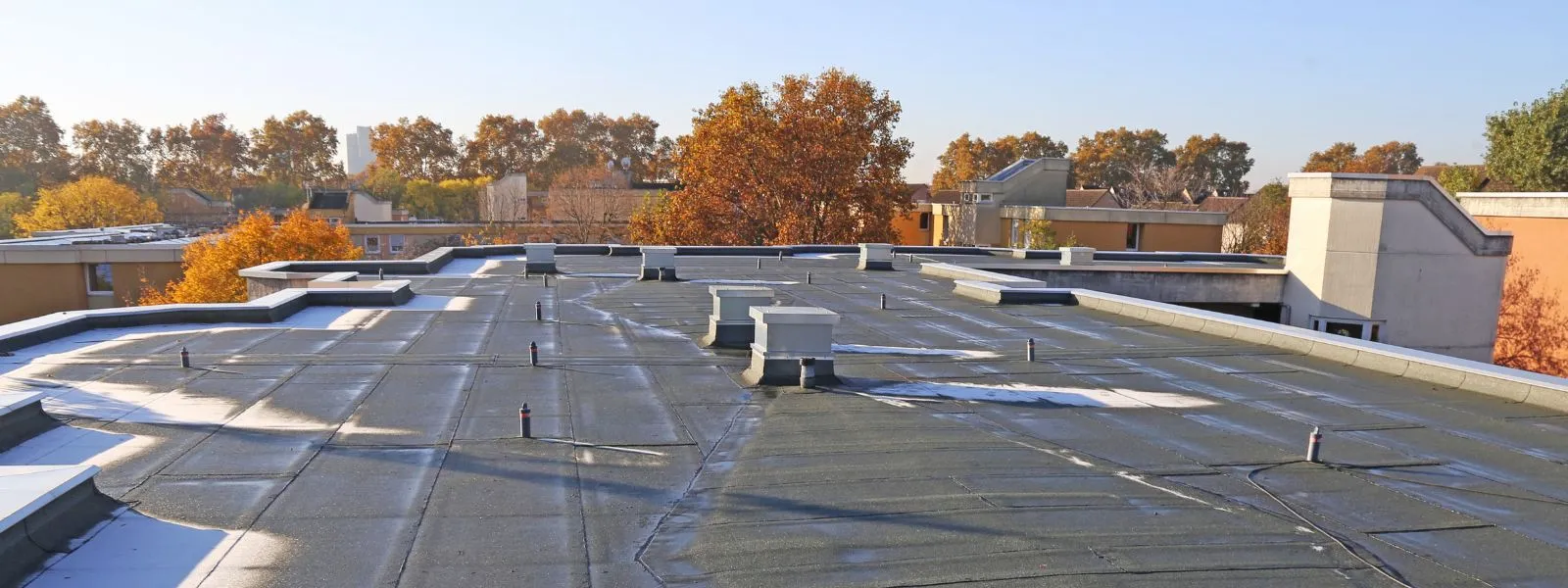
EPDM is a membrane, the waterproof layer that does the work a tile or slate does on a pitched roof. It is cured rubber, so it stretches slightly, which lets it follow small movements in the deck without splitting. It is also supplied as a large sheet, and on a typical garage or small extension the whole roof can be covered with one piece and no join across the middle.
That construction is the contrast with felt, which is laid in strips that overlap, and with GRP, which is built up in liquid layers on site. You can see the three side by side in our guides to torch-on felt and GRP fibreglass.
Published lifespans for EPDM are generally long. GreenSpec expects 20 to 30 years of service, Less (March 2026) says 30 to 50 and CORC says 50 or more. A safe summary is 20 to 30 years or more, never a promise, with the laying and the upkeep deciding where a given roof lands.
What it looks like
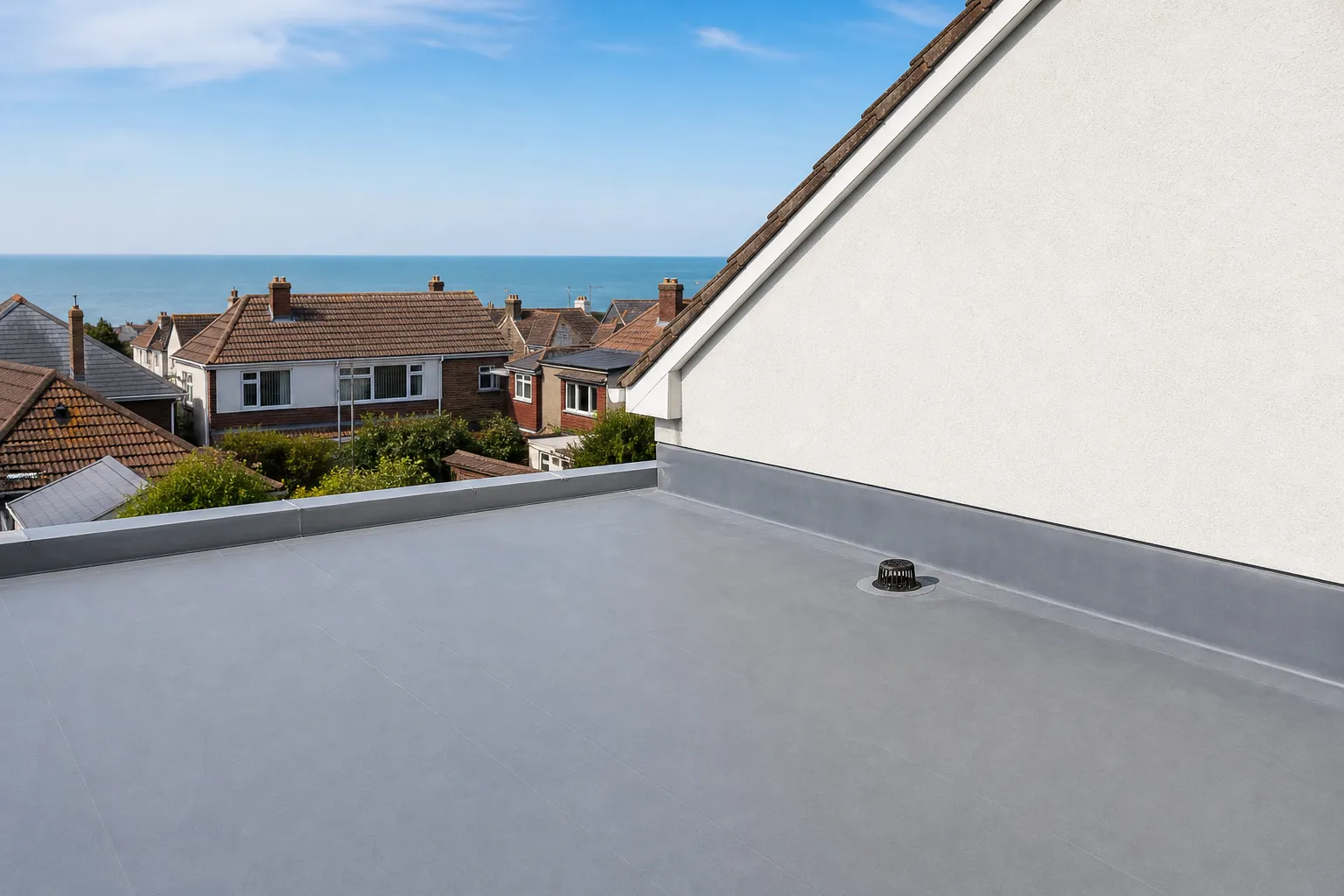
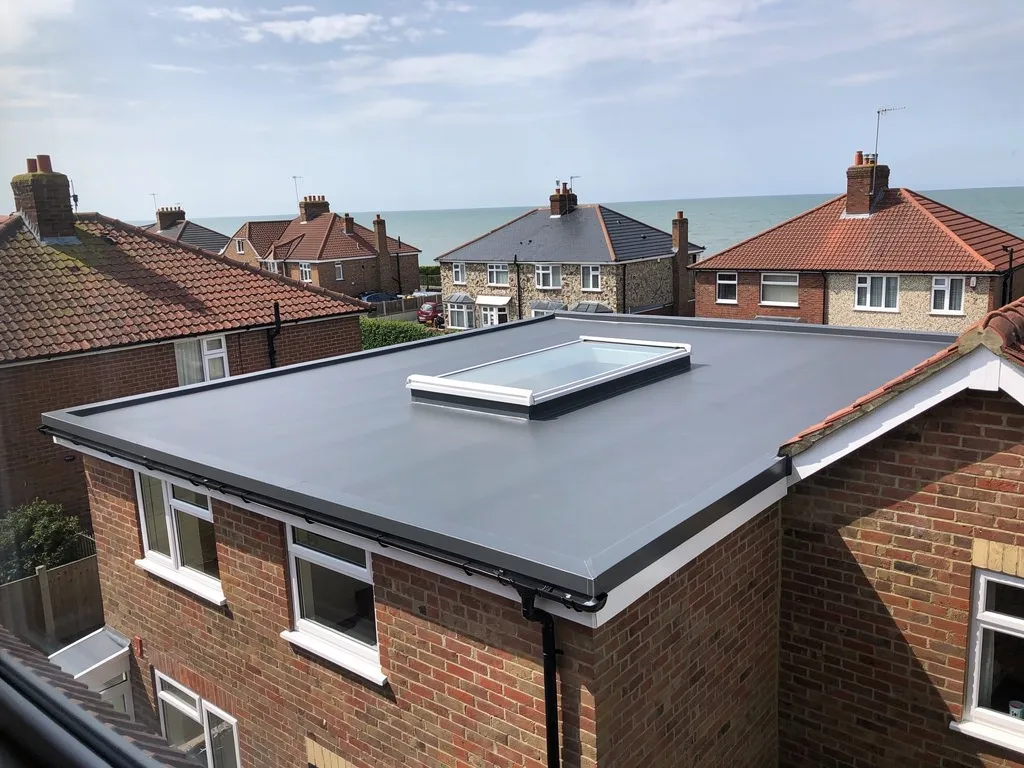
The finished surface is a smooth black rubber, with seams that show as a narrow strip of tape and edges finished with a metal or rubber trim. It does not have the grain of felt or the gloss of GRP. On a roof that is overlooked from upstairs windows it looks neat, and on one that is hidden the appearance matters little.
Rubber roofing is also sold for sheds and outbuildings. The product is the same, but the details on a house, where water coming in would damage rooms below, deserve more care.
How an EPDM roof is laid
A good EPDM job begins before the rubber arrives. The deck is checked for rot, loose boards and anything that could puncture the sheet from below, such as a protruding nail head or a sharp edge. Old coverings are stripped where they are failing, and damp or soft timber is replaced. The deck must be clean and dry, because the adhesive will not grip dust or moisture.
Falls and insulation
Water has to run off. IKO, citing the 2018 edition of BS 6229 (since revised), recommends designing a flat roof with a fall of 1:40 so that, after tolerances, the finished minimum is 1:80. A roof that ponds will test any membrane. Where the roof is being renewed, Approved Document L can require the insulation to be upgraded, and in a warm roof that insulation sits above the deck, under the rubber. We handle the Building Regulations notification where the work is notifiable.
Fixing the sheet
There are three ways of holding EPDM down. In the fully adhered method, a bonding adhesive is rolled on to the deck and the sheet, which is pressed into place from one side to the other. Mechanically fixed systems use plates and screws along the edges and sometimes the field. Ballasted systems rely on stones or paving on top, which is rarely used on houses because of the weight.
Fully adhered is the usual method on a domestic roof, because it makes the sheet and deck act as one and resists billowing in the wind. The sheet is relaxed after unrolling so that it settles flat before it is glued, and the adhesive is allowed to reach the right tackiness before the two surfaces meet. Rushing that step leaves bubbles.
The next section covers the part of the job where trouble usually begins, the joins and the finish.

Seams, trims and the details that matter
A single sheet is only possible where the roof is smaller than the roll. On larger roofs two sheets meet, and that join is a seam. EPDM seams are formed with a seam tape or a splice adhesive applied to clean, primed rubber and then pressed firmly with a roller. This is a handwork stage, and it is where care and cleanliness show. A seam laid in dust or damp is the likeliest early failure on a rubber roof.
Upstands, corners and penetrations
Where the roof meets a wall, the sheet is turned up the brickwork as an upstand, and a flashing finishes the top edge so that water cannot run behind it. Corners are formed with pre-cut or shaped pieces, not folded and glued from the flat sheet, because a folded corner leaves a pleat that can open. Pipes and rooflight kerbs get their own collars or flashing pieces.
These details are the same family as the joints that cause leaks on pitched roofs, and the rule that applies there holds here. Water seldom gets through the middle of a membrane. It finds the edge, the corner or the flashing, which is why we look there first when tracing a leak.
Edges and trims
At the eaves, a drip trim carries water clear of the fascia and into the gutter. At the verge or the open edges, a trim holds the membrane down firmly against wind. The strongest suction on any flat roof acts at the edges and corners, so the fixing there deserves care. Our guide to flat roof wind uplift explains why.
Ask how the perimeter is fixed, which trim system is used, and whether the sheet is fully adhered. Those three answers tell you more about the quality of a quote than the name of the membrane.
Lifespan and cost
MyBuilder's flat roof cost guide (updated 21/08/2026) gives a typical UK range of £90 to £130 per m² for EPDM, compared with £70 to £100 for felt, £95 to £150 for GRP and £95 to £140 for PVC. For a garage, the same company's garage roof guide gives £70 to £100 per m² for EPDM, which suits a small, plain roof. Those are national figures and not a Watertight price list.
The overall bill depends on the factors that affect every flat roof. The area and the shape come first. Access follows, because a first-floor roof needs scaffold, which MyBuilder puts at around £850 to £1,200 for a standard two-storey house. The state of the deck matters, since rotten boards add timber and labour. Insulation may be needed under Part L if the membrane is being replaced. A re-roof carries VAT at the standard 20%, and any insulation relief hangs on whether it counts as a separate supply, so ask the quote to spell out the VAT position. Our guide to flat roof costs goes through each factor in turn.
Cost against life
The lifespan figures above run from 20 to 50 years or more, and the sources disagree. EPDM costs a little more than felt to lay and is generally expected to last longer, so the cost per year of service tends to favour it, provided the laying is sound. If you want a view of the whole question, read about how long a flat roof lasts.
A manufacturer's warranty on the sheet is not the same as a guarantee on the work, so ask any roofer separately what they stand behind on the laying, the seams and the edge trims.
Where EPDM suits a house, and where it does not
EPDM works well on plain, medium-sized flat roofs where the sheet can go down in one piece or two. Garages, single-storey rear extensions, porches and the flat parts of dormers are the usual places. It copes well with a roof that needs to flex a little, because the rubber moves with the deck.
It is less suited to a roof that is heavily used. A rubber surface can be cut by sharp objects and worn by regular foot traffic, so a roof terrace usually calls for a different covering or a properly designed decked area on top, as our pages on a flat roof terrace and a walk-on flat roof explain. A roof with dozens of small penetrations and awkward corners may be easier to detail in GRP, where the resin runs round shapes without needing pre-formed pieces.
Near the sea
On this coast the sea weather tests every roof, mostly at the edges, the fixings and the laps. EPDM does not rust or rot, and the real protection is a sheet that is fully adhered, trims that are firmly fixed and an upstand that is properly sealed. Sheltered or exposed, the details do the work.
Fire and heat
Rubber is not a covering to expose to flame or concentrated heat. Do not put a barbecue, a heater flue or hot work near an EPDM roof without checking first.
If you are weighing it against GRP in particular, read about EPDM against GRP.
Keeping a rubber roof sound
EPDM asks for less attention than most coverings, but not none. Twice a year, and after any big storm, take a look at the roof, from a window or a safe ladder, without stepping on it. Leaves, moss and the debris that blows onto a roof gather at the outlets and the edges and hold water where it should not stay. Clearing them is simple, and blocked outlets are one of the commonest reasons a flat roof ponds.
Look for lifted seams, trims that have worked loose, cracks in sealant around penetrations and any place where the sheet no longer lies flat against the deck. Soft, spongy patches underfoot or stains on the ceiling below suggest water is getting in somewhere. Fix small faults before they spread, because a lifted edge will catch the wind again.
Repairs
Small cuts and splits are mended with a patch of the same rubber over a clean, primed area, stuck with adhesive tape. The preparation matters more than the patch. Where the damage is old, the area around it may be wet, and a patch over a wet deck seals the problem in. That is why a leak is traced to its entry point first, then repaired, and the survey photographs show you what was found.
After a storm
Gales can lift an edge, drive debris onto the roof or tear a trim. Active leaks come first for us. The opening is covered so the house stays dry, and the proper repair or recovering follows when conditions allow. A roof that has failed in several places, or whose deck is damp throughout, may be better renewed, and we will say so after the survey.