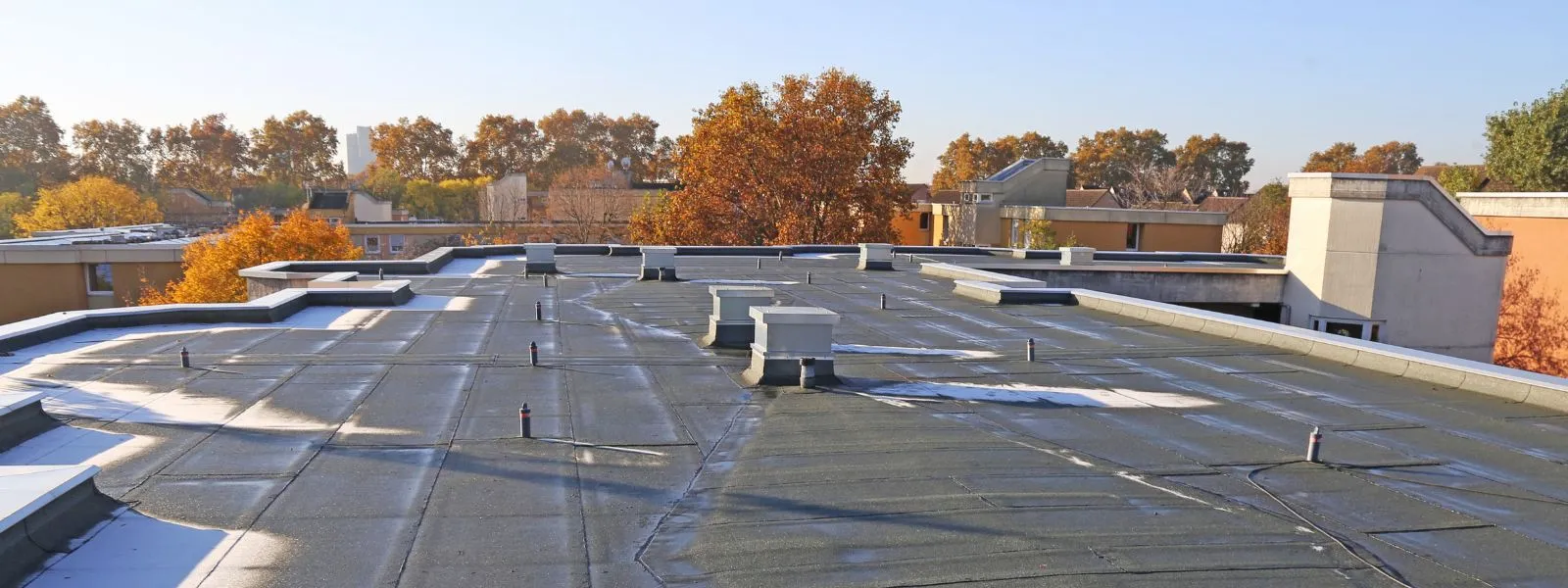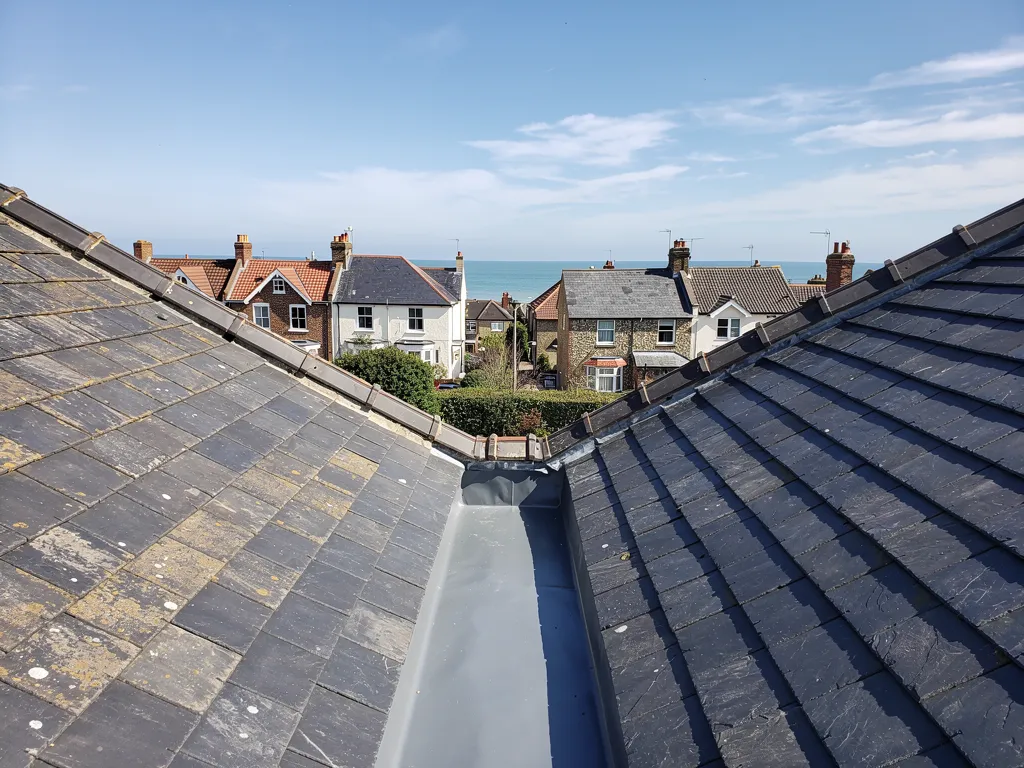
Pick the wrong covering for a flat roof and you find out slowly: a seam that lifts after a few winters, a surface that cracks where the deck moves, a bill that looked low and kept growing. Pick the right one and the roof is the part of the house you stop thinking about. The difference is rarely the brand. It is the match between the material, the shape of the roof, how it is used and how it is looked after.
This guide compares the five coverings you are likely to be offered on a house, garage or extension in Worthing and along the Sussex coast: bitumen felt, EPDM rubber, GRP fibreglass, PVC membrane and lead. It looks at four things in turn, which are how long each tends to last, what it costs, how it looks and how easily it can be repaired.
Our flat roofing hub covers the full service, and three of these coverings have their own guides, for EPDM rubber, GRP fibreglass and torch-on felt, so this one stays on the comparison.
The five coverings side by side
Here are the headline figures, all typical UK ranges from published guides and none of them promises. Costs are per square metre from MyBuilder's flat roof cost guide (updated 21/08/2026). Lifespans come from Less (March 2026) and CORC, with GreenSpec for EPDM.
| Covering | Cost per m² (UK) | Life (UK guides) |
|---|---|---|
| Torch-on felt | £70 to £100 | 10 to 20 years, some sources say 30+ |
| EPDM rubber | £90 to £130 | 20 to 30 years or more |
| GRP fibreglass | £95 to £150 | 25 to 40 years |
| PVC single-ply | £95 to £140 | Depends on welds and detailing |
| Lead | £150 to £200+ | 50 to 100 years |
MyBuilder describes flat roofs generally as lasting 15 to 30 years, which is a fair summary of where most of this table sits.
The costs apply to a full replacement over a sound deck. Repairs are priced differently, because a small patch carries the same set-up effort as a larger area, so a per-m² repair figure runs higher than a per-m² new-roof figure.
What the table cannot show
A table flattens everything that matters on a particular roof. It says nothing about the boards underneath, the falls that carry water to the outlet, the number of penetrations or whether anybody walks on the surface. Two roofs covered with the same material can age very differently, which is why the rest of this guide looks at what drives the choice and not only the numbers.
Read the table as a shortlist. Felt and EPDM are the usual starting pair when budget leads, GRP is the usual answer for awkward shapes and walk-on use, and lead is a specialist choice for small or visible areas.
Lifespan: why the sources disagree
Ask three sources how long a felt roof lasts and you get three answers. Less says 10 to 20 years, and says a well-laid felt job can reach 20 where a careless one gives up before 10. CORC says a well-maintained torch-on roof can run to 30 years or more. For EPDM, GreenSpec says 20 to 30 years, Less says 30 to 50 and CORC says 50 or more. GRP is steadier, at 25 to 40 years from Less and 25 or more from CORC.
The gaps are not carelessness. Each figure assumes different conditions, and the biggest variable is rarely the material. A covering over a sound, dry deck with good falls and clear outlets will outlast the same covering laid on damp boards where water pools. Foot traffic, hot sun, leaves and the quality of the laps and seams all move the result. Workmanship decides more than the datasheet does.
Lifespan is not the same as warranty
Manufacturers publish warranties, and a warranty is a promise about the product on set terms, rather than a forecast of the roof's working life. Neither tells you what a roofer will stand behind. The detail worth asking about is the workmanship cover from the roofer, because that is what applies to the laying, the upstands and the edge trims.
When a roofer quotes a long life for a covering, ask what that figure rests on. If the answer is the manufacturer's literature alone, remember that sea weather, a partly shaded or sun-baked slope, and a busy household all sit outside the lab.
For the simplest summary of a finished roof's prospects, look at the preparation. Good falls, a dry deck and tidy edges matter more than any single covering.

Cost to lay and cost to own
The table gives the cost to lay. The cost to own adds the repairs, the cleaning and the day the roof has to be replaced, divided across the years it lasts.
That calculation can reverse the order. Felt at £70 to £100 per m² has the lowest bill on day one. If it lasts 15 years and an EPDM roof costing a little more lasts 30, the rubber roof costs less per year, as long as both are laid well. Equally, a felt roof that survives 25 years has done its job at a low price. Because sources disagree about both, the sums are only as certain as the lifespans, and honest comparison keeps that in view.
Where the extra money goes
Part of the premium for GRP and PVC pays for fewer joints, and part pays for skilled labour. Lead costs most because the material is expensive and each roll and joint is formed by hand. A premium covering will not rescue a poor deck, so check the whole specification before judging it by the line that names the material.
Edge trims, outlets, upstands and insulation also add to the final figure, whatever covering sits on top. Our guide to what a flat roof costs goes through each of those and the VAT position.
A cheaper covering is a fair choice on a small, plain roof that you can inspect and maintain. It becomes a poor one when the roof is hard to reach, because every future repair then carries the cost of access.
Where a roof is awkward and an inspection means scaffolding, the argument for a longer-lived covering strengthens. Where a garage roof can be reached with a ladder, a shorter life is less of a worry.
Appearance and how the roof is used
On many houses a flat roof is out of sight. On others it is seen from upstairs windows, from a neighbour's garden or from a terrace, and then the look counts.
Felt is dark and slightly textured, usually finished with a mineral cap sheet in grey or black. EPDM is a plain black rubber, smooth, with visible tape at the seams, though it can be trimmed neatly at the edges. GRP takes a coloured topcoat and reads as a smooth, continuous shell, which many people prefer on a balcony or a dormer cheek. PVC membranes come in several colours, typically light grey tones. Lead weathers to a soft grey and suits period buildings.
Walking, sitting and planting
If you want to step out onto the roof, the surface and the structure both matter. GRP is the usual choice for a walk-on deck, and our terrace and walk-on pages set out what the structure underneath has to provide. A living sedum layer is a different proposition again, because the weight and the drainage need checking by someone who knows the structure.
Roofs that once had a practical purpose are often put to new uses, from storage to a place to sit. The reasons a house has a flat section in the first place are explained in why houses have flat roofs, which helps in deciding whether a particular roof is worth putting to work.
None of this changes the first requirement, which is that the roof sheds water. A pleasant finish laid over a poor fall is still a poor roof, and the look should come after the build-up is right.
Repairability: what happens when it is damaged
Every roof gets damaged eventually, by a branch, a ladder, a dropped tool or a long run of frost and sun. How easily the covering can be repaired is a real part of the choice.
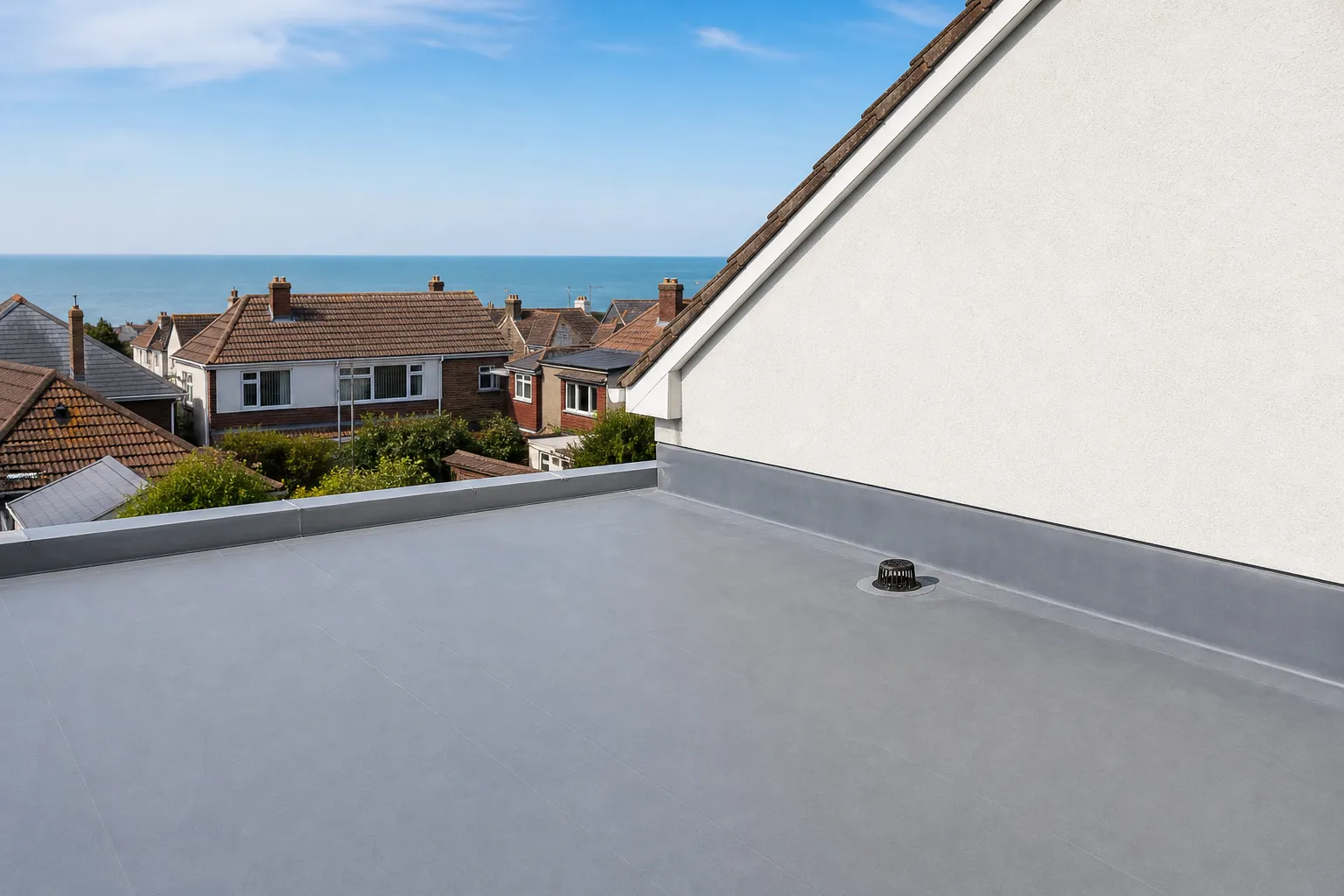
Felt can be patched with new sheet torched over the damage, which makes small repairs cheap, although repeated patching leaves a roof of mixed ages that fails at the joins. EPDM is repaired with a clean, dry patch and adhesive tape, and the surface needs to be properly prepared for the patch to hold. GRP can be repaired with resin and matting, but a repair has to be laid in dry weather and may show as a different shade. PVC is repaired by heat welding a new piece in. Lead can be dressed, soldered or patched by a skilled hand, and lasts so long that repairs are rare.
Finding the fault comes first
With any membrane, water can enter in one place and show inside some distance away, because it runs along the deck or under the covering before it appears. A patch on the visible blister may therefore miss the real entry. That is why we find where the water starts before choosing between a repair and a new covering, and why survey photographs of the roof come with the written quote.
The question of when a repair stops being sensible is covered under repairing or replacing a flat roof, and the price side of it in the cost guide.
As a rule, simpler detailing repairs better. A roof with few penetrations, clean edges and good access can be repaired quickly in any material. One cut up with rooflights and steps is harder to keep tight.
Matching the covering to your roof
Start with the roof, not the material. Work through four points and a covering usually picks itself.
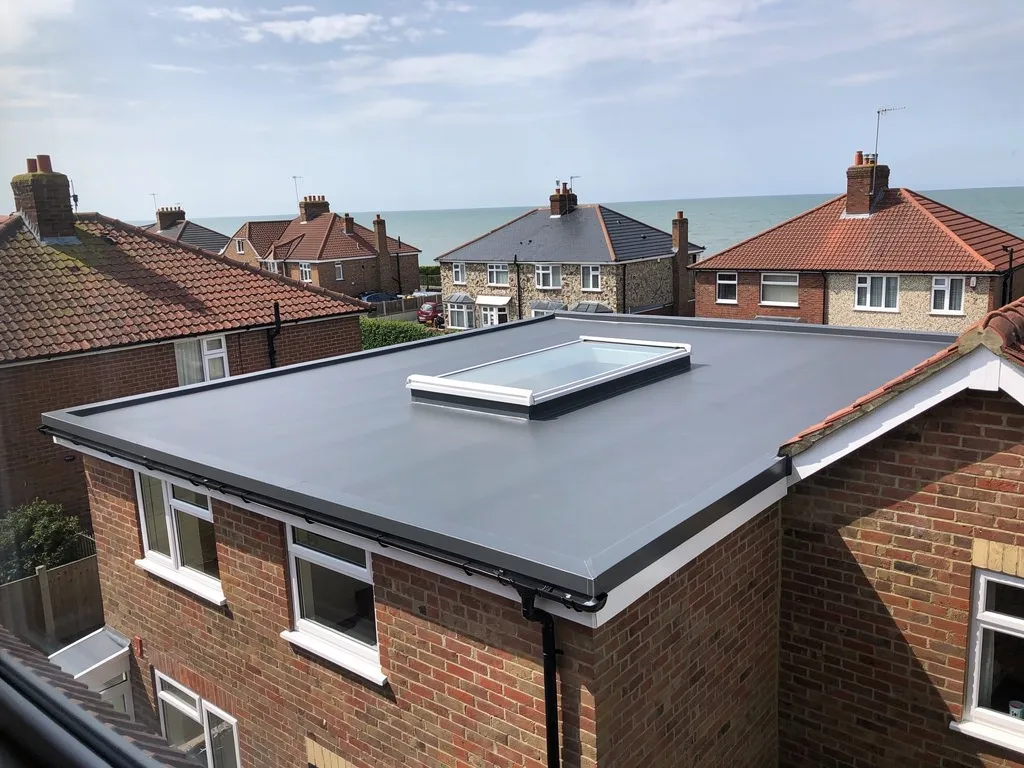
First, the shape. A simple rectangle suits sheet materials such as EPDM, which can be laid in one piece. A roof with many corners, upstands, rooflights or a curved edge suits GRP or PVC, where the detailing can be moulded or welded. Second, the access. If the roof can be reached and checked easily, a shorter-lived covering carries less risk. If every visit means scaffolding, pay for the longer life. Third, the use. A roof that is walked on needs a hard-wearing surface. Fourth, the budget over time, not only at the start.
The coast changes the detailing more than the material
Sea weather puts most of its stress on the edges, the laps and the fixings, wherever the roof is in Sussex. Whichever covering you choose, ask how the perimeter will be fixed and finished, and whether the falls are designed at 1:40 to leave a finished minimum of 1:80 once tolerances are taken up, the guidance IKO gives citing the 2018 edition of BS 6229 (since revised). A flat roof that holds water finds its weak point.
If you are replacing an existing covering, say which material is on the roof now. Changing to a different type is possible, but the deck, the edges and the upstands may need work to suit.
Send us photographs of your roof or ask for a survey, and we will say which covering we would choose for it and why. If two suit equally well, we will say that too, and the quote we write for the option you pick comes as one figure covering everything.