
Flat roofing in Worthing

We install, repair and replace flat roofs on Worthing extensions, garages, dormers and seafront blocks, and we choose the membrane that suits the deck, the sea weather and the way you use the roof.

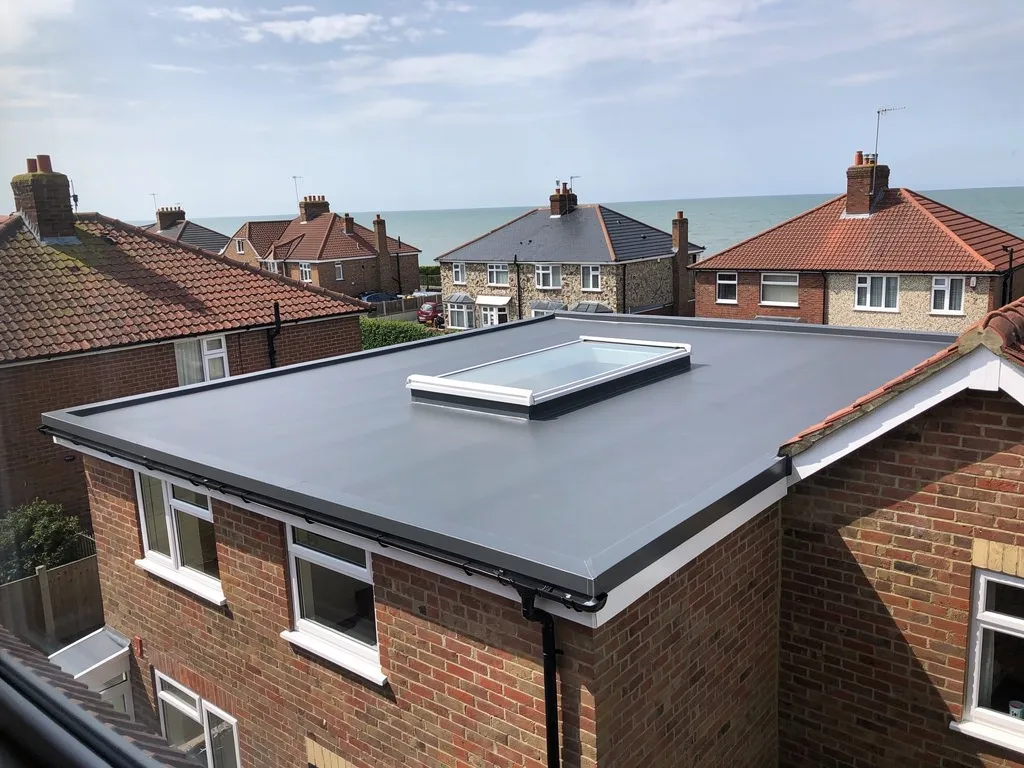
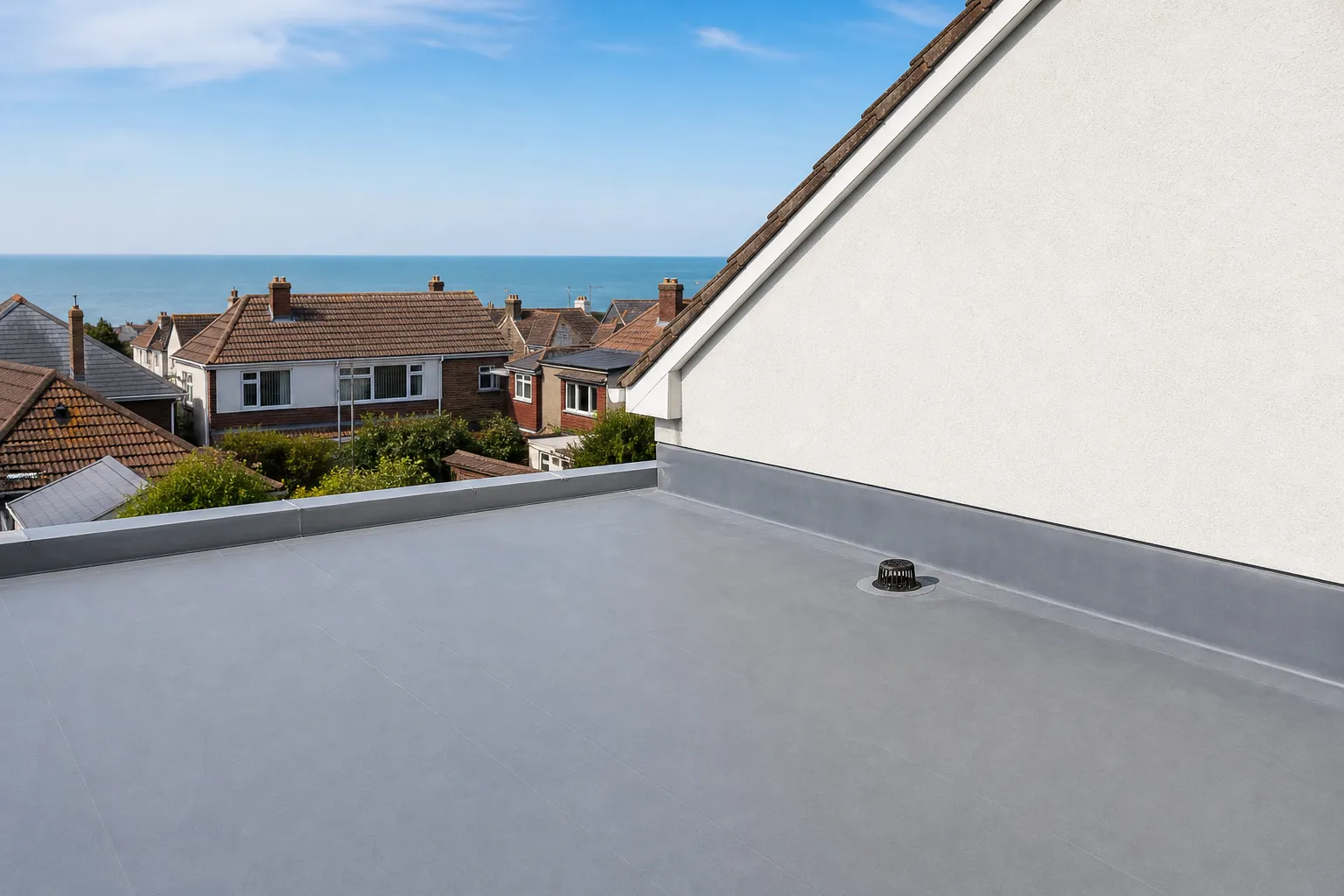
New single-ply membrane flat roof with a welded upstand and edge trim near the sea
  • Leaks traced
    to the source
  • Photos of
    your own roof
  • Written quote,
    one total price
  • 10-year workmanship
    guarantee, in writing

Flat roofing services we cover in Worthing

  • EPDM rubber roofs

    One large sheet of synthetic rubber laid over the deck with few joints, suited to extensions, garages and the flat tops of dormers.

  • GRP fibreglass roofs

    A fibreglass laminate laid wet and cured hard on the roof, joint-free across the field, and a sound choice for balconies and walked-on roofs.

  • Torch-on felt roofs

    Layered bitumen sheets adhered with a gas torch, the traditional felt route, with a proven build-up that most roofers can patch.

  • Flat roof repairs

    Splits, blisters, lifted edges and failed outlets mended when the deck beneath is dry and firm and the covering around the fault has life left.

  • Re-covering and insulation

    A worn covering stripped, the deck made good, the falls corrected and a new membrane laid over insulation that meets the current Part L standard.

  • Edges, outlets and upstands

    Drip trims, gutters, outlets and the upturns at walls, the details where a flat roof so often starts to leak, renewed with the covering.

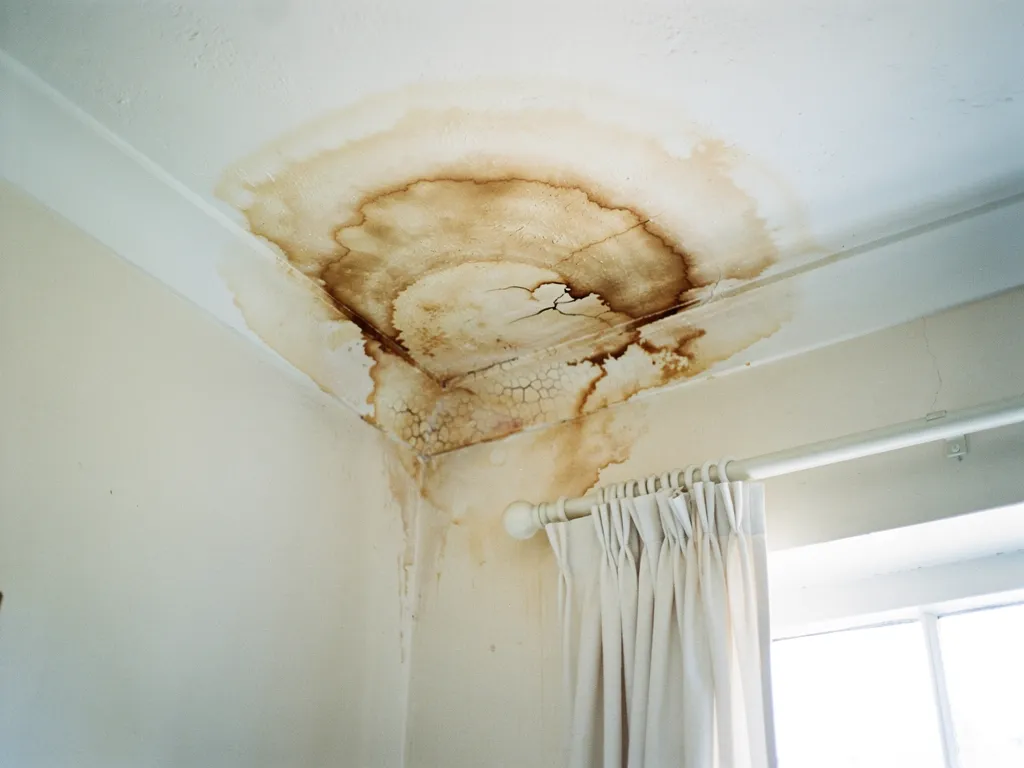
Brown water stain spreading across a white bedroom ceiling near the window

Signs a flat roof needs attention

  • Puddles that stay for days
  • Blisters, bubbles or cracks in the felt
  • A ceiling stain that grows after rain
  • Lifted edges or open laps at the wall
  • A gutter or outlet overflowing onto the roof

Typical UK costs for flat roofing

Typical UK price ranges
JobUK range
Complete flat roof, typical job£2,800 to £7,500
Flat roof section on a semi-detached house£2,500 to £6,000
Felt flat roof repair, per m²£100 to £140
EPDM flat roof repair, per m²£120 to £170
GRP flat roof repair, per m²£130 to £180

The ranges above come from published UK guides and describe typical flat roofs elsewhere. After we have surveyed yours, the written figure you receive covers the whole job in one sum. Source: MyBuilder flat roof cost and new roof cost guides, updated 21/08/2026; Checkatrade roof repair cost guide, table last updated June 2026 (excluding VAT).

The step by step process for a flat roof job

  1. Survey the roofWe walk the roof safely, test the deck for soft spots, and photograph ponding, laps and outlets, then look at the ceiling below.
  2. Agree the build-upYou see the photographs and a plain choice between repair, overlay and strip-and-renew, with the membrane we would lay and why.
  3. Strip, deck and layThe old covering comes off where it has to, the deck is made good, the falls are set and the new membrane goes down in dry weather.
  4. Finish, check, tidyEdges, upstands and outlets are finished and inspected, the finished roof is photographed, and the site is cleared with the waste taken away.

The flat roofing guide

Choosing, laying and looking after a flat roof by the sea

How felt, EPDM and GRP compare, why falls and insulation decide the build, when a repair is enough, and what the work typically costs.

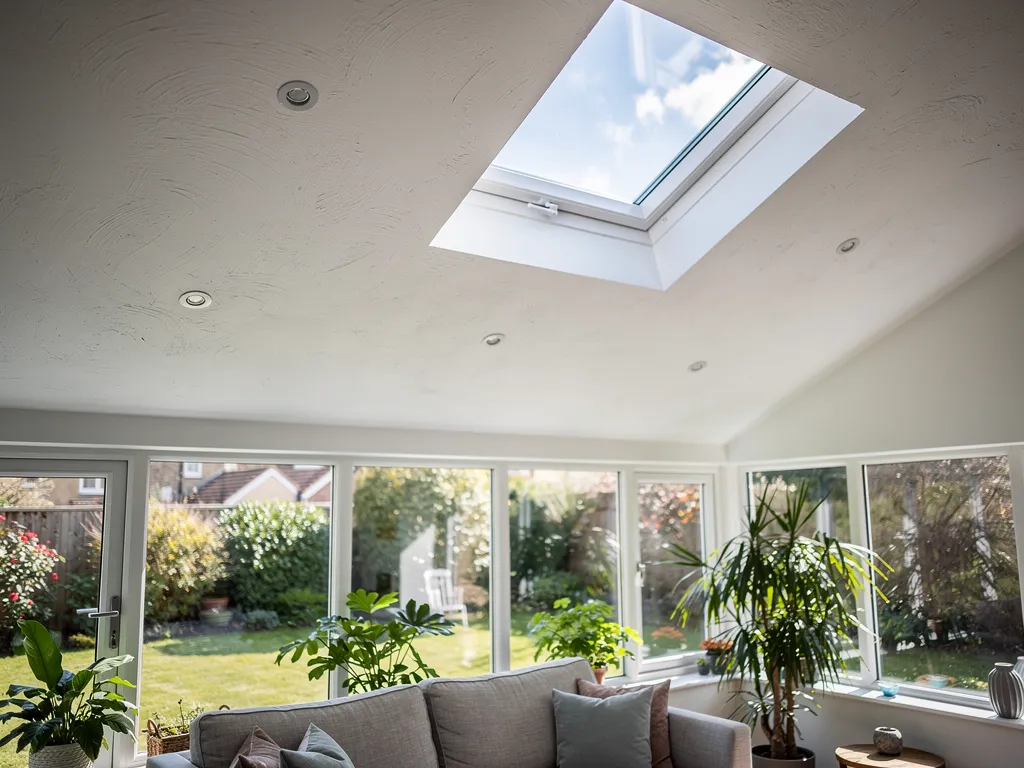
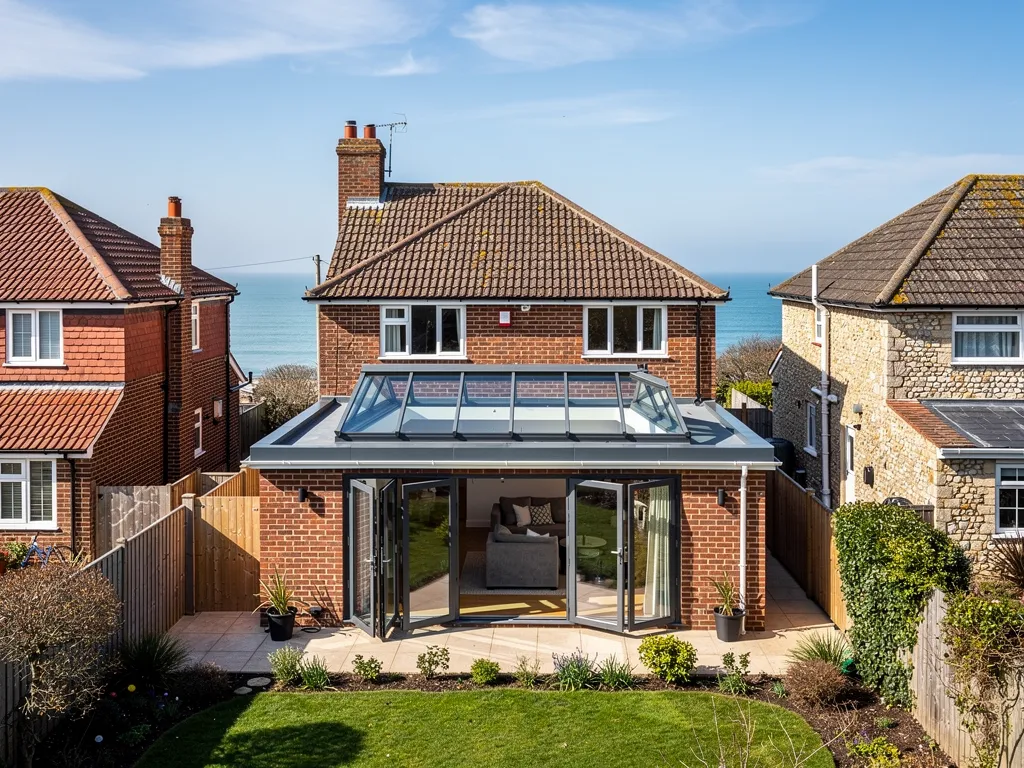
Glass roof lantern on a flat-roofed extension seen from the garden

Chapter one

Felt, EPDM or GRP for a Worthing flat roof

Each of the three main coverings has strengths and a weak point, and the roof in front of us decides which one fits.

A flat roof is a low-slope roof with a waterproof membrane across it, and the membrane is the part you choose. Three coverings are in everyday use: torch-on felt, EPDM rubber and GRP fibreglass. Each is more than a sheet of material. It sits on a deck, may have insulation under it, and finishes at trims, upstands and outlets, and together those make up the flat roofing system. The right flat roofing solution is the one that suits your deck, the shape of the roof and how it gets used, rather than a favourite material, and flat roof installation starts by deciding which type of flat roof the deck can carry.

At a glance

  • Felt, EPDM and GRP each suit different roofs
  • Published lives run from 10 to 40 years
  • The deck and falls matter as much as the membrane

1.1 Torch-on felt

Traditional felt is built from two or three layers of bitumen sheet, adhered to each other and to the deck with a gas torch, which is where the name comes from. It is a familiar build-up that most roofers can patch, and it suits straightforward rectangular roofs. Less puts the life of a felt roof at 10 to 20 years, and says a good felt job can run to about 20 years while a poor one may fail in under 10. The weak points are the laps and the upturns at walls, where the bitumen has to follow the roof as it warms and cools through the year. Our guide to torch-on felt roofing shows how a roof of this kind is built.

1.2 EPDM rubber

EPDM rubber is a synthetic membrane delivered in one large sheet, which on a garage or extension can run edge to edge without a seam across the middle. That moves attention to the perimeter, the corners and the outlets, where the sheet is folded, adhered and trimmed. GreenSpec gives an expected service life of 20 to 30 years for single-ply membranes, and other guides go higher, so 20 to 30 years or more is a fair planning range. Because the rubber stays flexible, it copes with a deck that moves a little. The guide to EPDM rubber roofing covers the detail.

1.3 GRP fibreglass

GRP is a glass-reinforced plastic. Resin and glass matting are laid wet on the deck and cure into one hard skin with no laps at all, which suits small balconies, roofs round dormers and roofs people walk on. Less gives 25 to 40 years. The skin is rigid, so it relies on a firm deck, and a deck that flexes can crack the laminate along a board joint. The GRP fibreglass roofing guide goes through it step by step.

The three main flat roof coverings compared

CoveringPublished lifeHow it is laidWhere it suits
Torch-on felt10 to 20 yearsLayers of bitumen sheet, torch-adheredSimple outlines, quick patch repairs
EPDM rubber20 to 30 years or moreOne sheet, adhered and trimmed at the edgesLarger roofs with few penetrations
GRP fibreglass25 to 40 yearsWet resin and glass matting, cured in placeBalconies, awkward shapes, foot traffic
Source: Less flat roof cost guide (March 2026); GreenSpec single-ply membranes

The membrane is only as good as the deck and the falls beneath it.

No covering wins every time. Quality materials matter, but so does the person laying them: a high quality flat roof is a sound deck, correct falls and tidy edge details first, with the membrane on top. A high performance membrane laid over a ponding deck still fails early. Our flat roof materials comparison sets the three side by side, and the table above shows the lives published for each.
Chapter two

Falls, ponding and where the rain goes

A flat roof that holds water works on every joint in its covering, so the slope is part of the waterproofing.

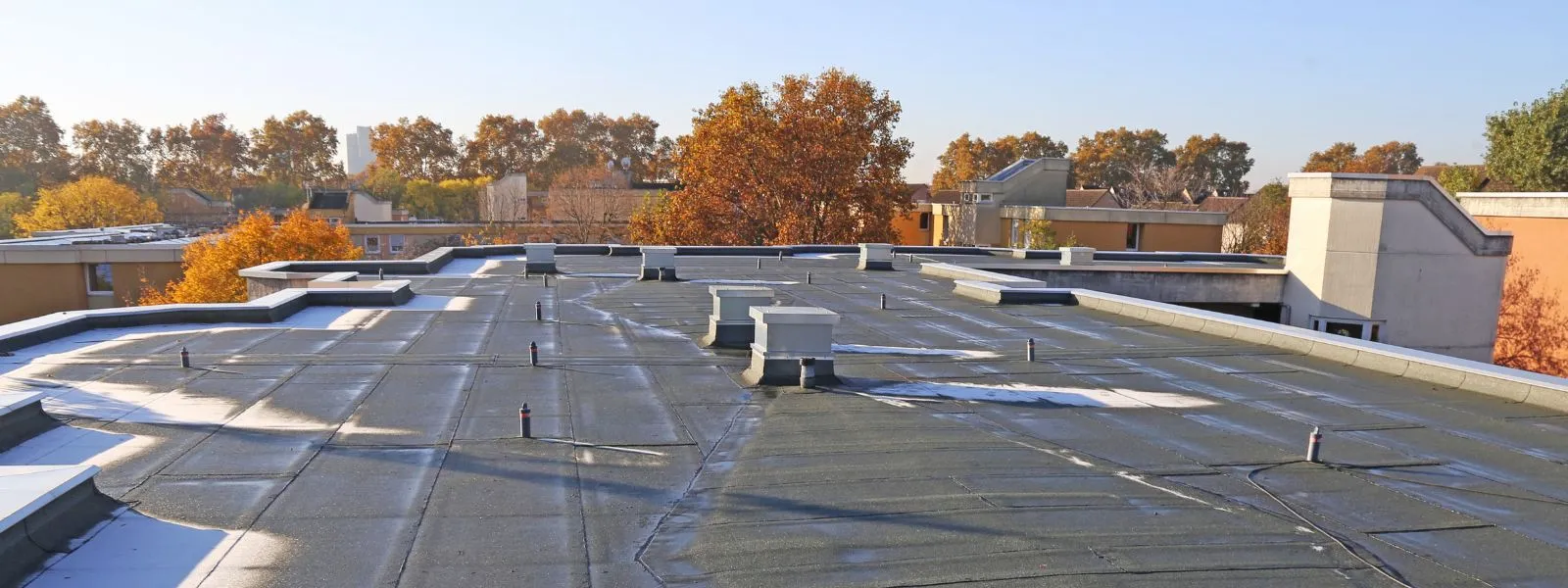
Large felt flat roof with upstands and vents, autumn trees

Every flat roof needs to fall towards an outlet, because water with nowhere to go works on the membrane all day. IKO, citing the 2018 edition of BS 6229 (since revised), gives 1:80 as the recommended minimum fall and advises designing for 1:40, so the finished roof still reaches 1:80 once building tolerances and deflection of the structure are allowed for. In plain terms, 1:40 is a drop of 25 mm over each metre, and the finished roof should never drop less than 12.5 mm over a metre. A deck laid dead level, or one that has sagged since, is a common reason for a roof that is still wet days after the rain has stopped.

At a glance

  • Design a 1:40 fall to finish at 1:80
  • Ponding sits on every lap and upturn
  • Outlets and gutters need clearing as well as the roof

Note FloPlast recommends a 1:350 fall for its MiniFlo gutter; Brett Martin asks for 1mm in every 600mm.

2.1 What ponding does

A film of water that dries off quickly is one thing; puddles still there days later are another. Standing water sits on every lap and upturn, adds weight to the structure, lets algae and moss take hold, and in a cold snap can freeze and lever open a small gap. It also shortens the working life of any covering, and the published lifespan of each assumes the roof drains. The signs differ by material: a dark, soft patch on felt, a tide line of dirt on rubber, staining in the dip of a fibreglass roof.

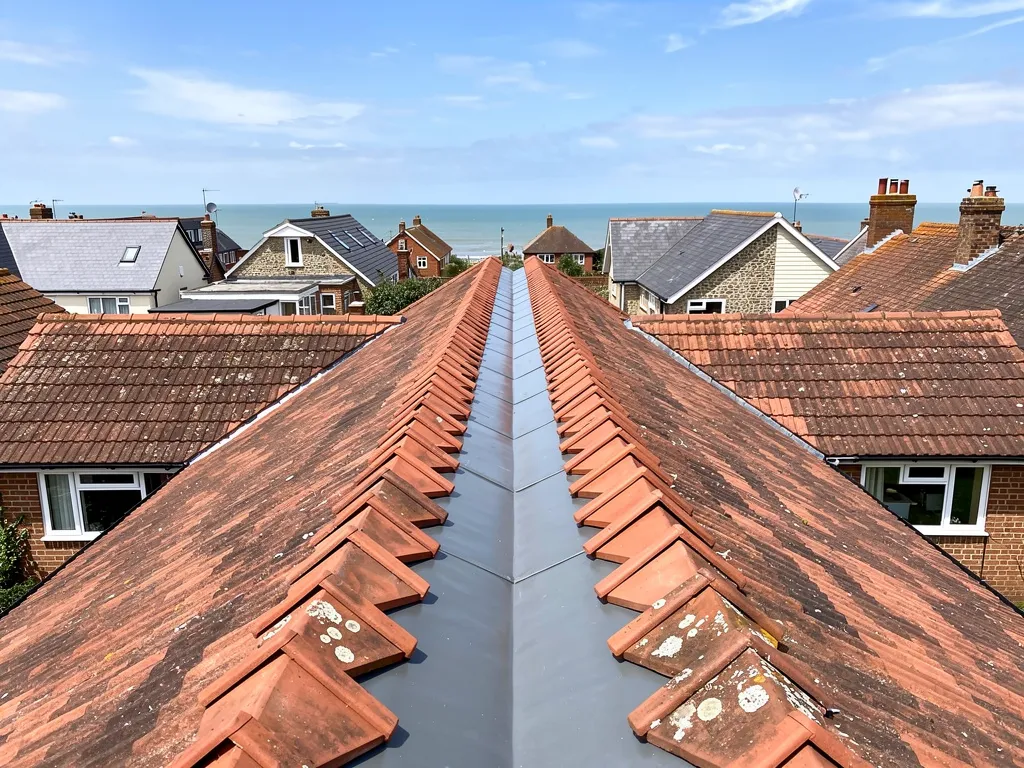
Lead-lined valley where two clay-tiled roof slopes meet

2.2 Outlets, gutters and edges

Water leaves a flat roof by one of three routes: over a drip trim into a gutter, through an outlet into a downpipe, or along a box gutter behind a parapet. A parapet roof behind a Victorian terrace front, or a flat roof on a seafront block, depends on that last route working. A leaf-choked outlet turns an ordinary shower into a pond, and an overflowing gutter can push water back under the lower edge of the membrane. We check each outlet and trim before we quote and photograph what we find. When we re-cover a roof we renew the trims and outlets with it, because new rubber adhered to a tired outlet is a poor pairing.

2.3 Putting the falls right

Where the old roof is too flat, the cure is built into the new one. Firring pieces, tapered timber strips fixed on top of the joists, can give the deck its slope, and tapered insulation boards can do the same job in a warm roof. Which method fits depends on the room below, the height of the door threshold and the trims at the wall. Changing a fall is design work, and it is far easier to do on the day the old covering is off than to add later.

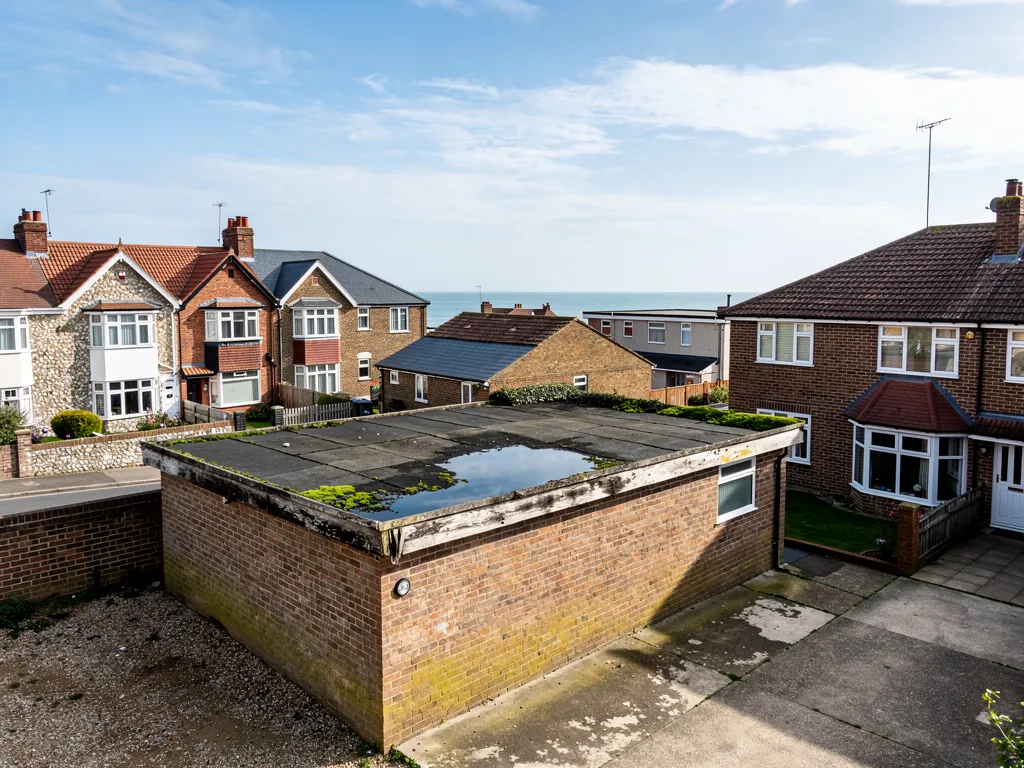
Single brick garage with a tired felt flat roof, ponding water and patches

Fig. 2 On the survey Water standing on the roof where the deck has sagged.

Lead-lined valley where two clay-tiled roof slopes meet

If you suspect ponding, photograph the roof from an upstairs window or the garden the morning after rain, and again two days later. Please do not climb up to look. Those two pictures show where the lowest ground is before we arrive, and they let us bring the right materials to the survey.

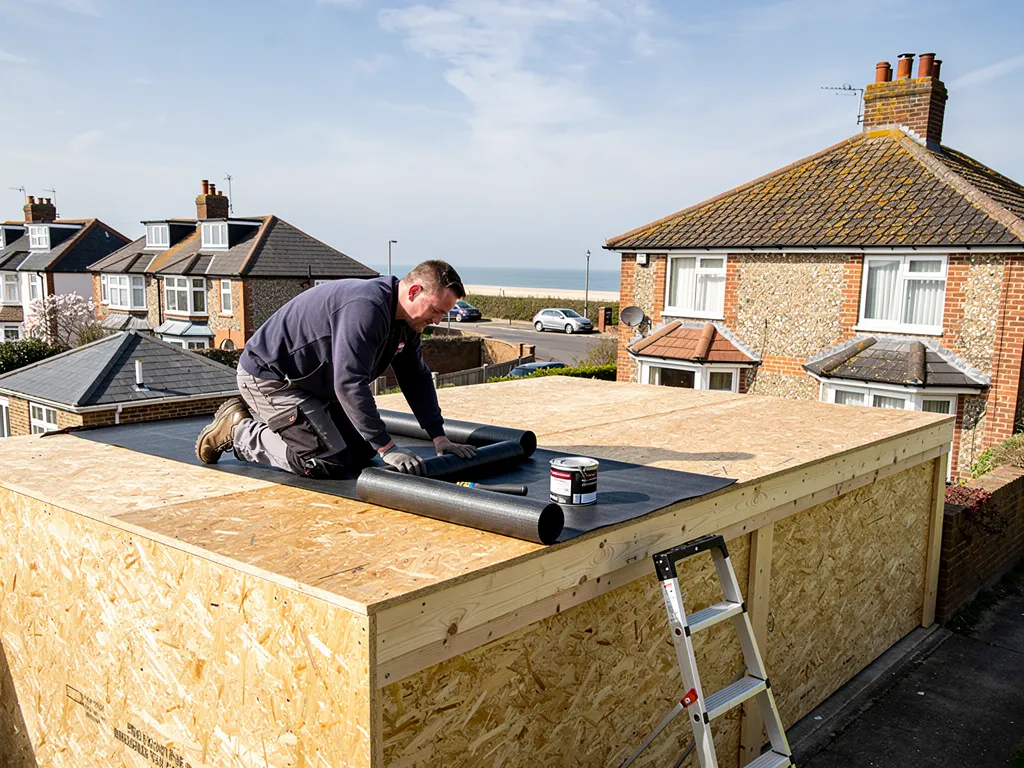
Roofer rolling out a new rubber membrane over fresh boards on a garage roof

Chapter three

Warm roofs, cold roofs and the insulation rules

How a flat roof is insulated decides how it is built, and replacing the membrane can bring the Part L standard into the job.

The insulation question comes first in flat roof design because it decides how the roof is built. In a warm roof the insulation sits on top of the deck and the waterproof membrane goes over it, so the deck and joists stay on the warm side. In a cold roof the insulation sits between the joists, under the deck, with a ventilated gap above it, and the timbers run cold. Both can work. Both go wrong when warm, damp air from the room below reaches a cold surface and condenses, which is why a vapour control layer or a ventilation path is part of the design. Our guide to warm and cold flat roofs compares them in full.

At a glance

  • Warm roofs insulate above the deck
  • Replacing the membrane counts as renovating the roof
  • Over 50% of the surface renovated upgrades the whole element

3.1 Part L when the membrane is replaced

Approved Document L counts stripping and relaying the waterproof layer of a flat roof as renovating a thermal element. Where more than 50% of the surface of that element is renovated, the whole element is upgraded, and the document's table for existing elements lists a threshold of 0.35 and an improved figure of 0.16 W/(m²·K) for roofs. A major renovation, defined as more than 25% of the surface area of the external building envelope, leads to the same upgrade. For you, a new covering on a flat-roofed extension can come with thicker insulation than the old roof had, and so a taller roof edge and different trims. We explain which side of the line a job falls on at the survey, before you agree to anything.

3.2 Building control and weight

The Planning Portal sets the test for re-covering: no building control application is normally needed while less than 25 per cent of the total building envelope and less than 50 per cent of the roof is affected. Past those limits, or with a new covering 15 per cent or more heavier than the old, approval applies. Weight matters when a roof is to take paving, a green roof or a terrace, so we raise it early. Where the work is notifiable, we handle the Building Regulations notification with the council or a registered building control approver.

Insulation and weight rules in brief

Membrane replaced
Counts as renovating a thermal element
More than 50% renovated
The whole roof element is upgraded
Existing-element table
Threshold 0.35, improved 0.16 W/(m²·K)
New roof element
Limiting U-value 0.15 W/(m²·K)
Heavier covering
15 per cent or more heavier needs approval

Source: Approved Document L Vol 1 (2021 edition incorporating 2023 amendments), paras 11.2 and 11.3 and Tables 4.2 and 4.3; Planning Portal

Replacing the membrane can bring the insulation upgrade into the same job.

A rooflight or lantern set into a flat roof brings its own figures. Part L gives a limiting U-value of 2.2 W/(m²·K) for a rooflight, and says an upstand built on site should reach 0.35. We ask what is going into the roof at the survey, so the insulation and the kerb are designed together.

Chapter four

Repair, overlay or strip and renew?

A flat roof hides what lies beneath its covering, which makes the choice between a patch and a new roof harder to see.

Choose the smallest job that cures the fault. On a flat roof that is harder to judge than on a pitched one, because the covering hides the deck, and a patch can be exactly right or the first of many.

At a glance

  • A dry, firm deck and a covering with life left means repair
  • MyBuilder puts flat roof life at 15 to 30 years
  • An overlay only suits a dry, well-adhered old covering

Note On Less's March 2026 figures, a lead flat roof can last 50 to 100 years.

4.1 When a flat roof repair is enough

A localised split, a lifted edge, a failed outlet collar or a blister on an otherwise sound covering can be mended. On felt, that means cutting out the damaged area, drying the deck and adhering a new patch. On EPDM, a patch is adhered with primer and tape, and on GRP a crack is ground back and laminated again. The test is the same each time: is the deck dry and firm, and does the covering around the fault have life in it? If so, flat roof repair is the right call, and it costs far less than a new roof. We photograph the fault before and after so you can see the cause. Our roof repairs hub covers the wider picture.

4.2 Signs the covering has reached the end

Widespread blistering, felt that cracks when pressed, laps that open again after every repair, a soft or spongy deck underfoot and ceiling stains in several places all say the whole covering is finished. Wet insulation is another sign: it stops insulating and keeps the deck damp. MyBuilder puts the typical life of a flat roof at 15 to 30 years, and the covering and its upkeep decide where in that range yours sits. Repeated patching of a roof near the end of its life costs more across the years than renewing it once. That is flat roof replacement: strip to the deck, replace any rotten boards, set the falls, lay insulation and a new membrane. Our roof replacement hub covers full re-roofs of every kind.

4.3 Overlay or strip?

Laying a new membrane over the old is possible in some cases. It needs the old covering to be dry, firmly adhered and flat enough to carry the new one, and it adds weight and hides whatever lies beneath, including wet insulation. We recommend an overlay only where the survey backs it, and when stripping off is the better route, that is what the photographs will show. A stripped roof lets us inspect the deck itself, which is where problems can hide.

What people sayA flat roof only lasts ten years before it has to be replaced.

What is truePublished lives run from 10 to 20 years for felt up to 25 to 40 for GRP, and upkeep and workmanship decide where a roof falls.

Planning permission is not usually needed for a like-for-like re-cover, since the look of the building stays the same. A listed building is different, so speak to the council's planners before work starts. Conservation areas can add an Article 4 direction: those for Old Shoreham and Kingston Buci remove permitted development for roof alterations, coverings included, on homes fronting a highway or right of way. Ask the Adur and Worthing planning team before changing a covering in either place.

A roof with one clear fault and a dry deck wants a repair, not a new covering.

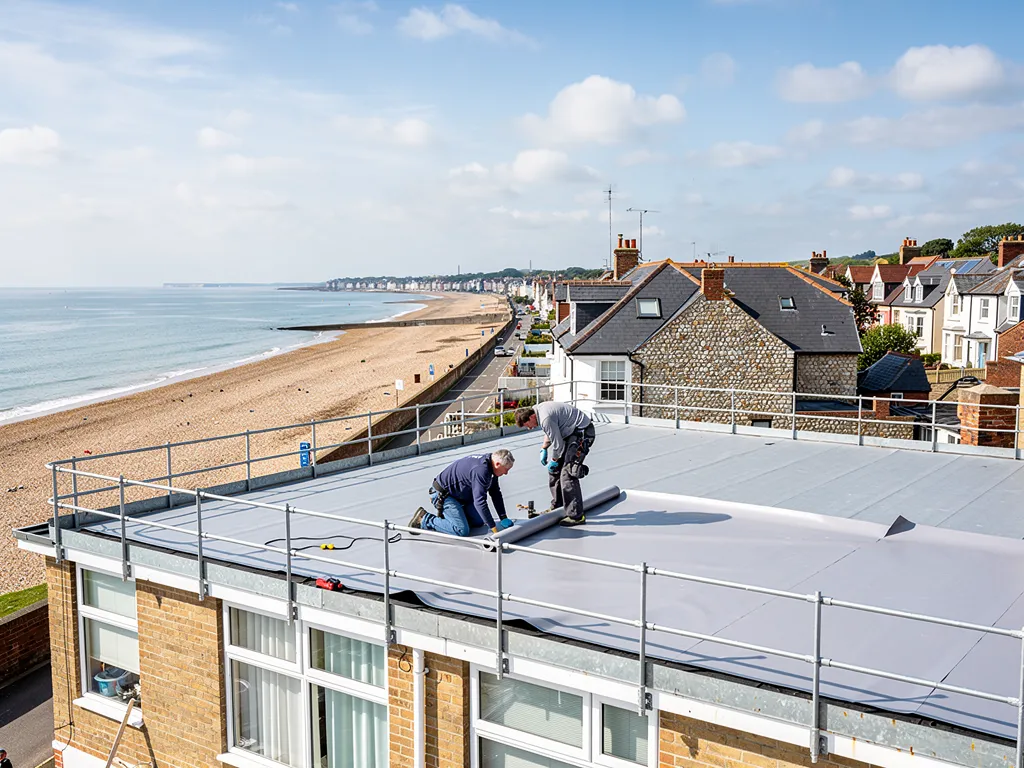
Roofers laying a single-ply membrane on a seafront flat roof

Chapter five

Salt air, gales and keeping a flat roof sound

The sea does not change what a good flat roof is, but it punishes weak edge details and rewards a short, regular check.

A flat roof on this coast faces the sea weather directly: gales off the Channel, driving rain and salt in the air. That applies from Goring and Ferring through Lancing and Shoreham to Hove. None of it changes what a good flat roof is, but it raises the price of a weak detail. A membrane is rarely beaten across the middle. It gives way at the perimeter, where wind can get under an edge, at corners where several folds meet, and at the upturn where the roof meets a wall. That is where we spend the most time at survey.

At a glance

  • Edges, corners and upturns take the wind first
  • Salt deposits gather where rain cannot rinse them
  • A twice-yearly check catches small faults early

Note Brett Martin's guidance spaces gutter supports no more than 900mm apart, worth checking on a run that sags after a gale.

5.1 Edges, trims and fixings

The trim along the edge of a flat roof does two jobs: it holds the membrane down against the wind and it throws water clear of the wall. A loose or corroded trim lets the edge lift. When we re-cover a roof, edge trims are fixed to suit the exposure, the membrane is adhered or held as its maker specifies, and upstands are finished to the height the maker asks for. Sealant is never asked to do the work of a fixing. HomeBuilding observes that salt collects under the eaves on soffits and fascias, out of reach of the rain, and the roofline beside a flat roof is no different, so we look at it while we are there. A reliable flat roof is a weather resistant one at the edges first.

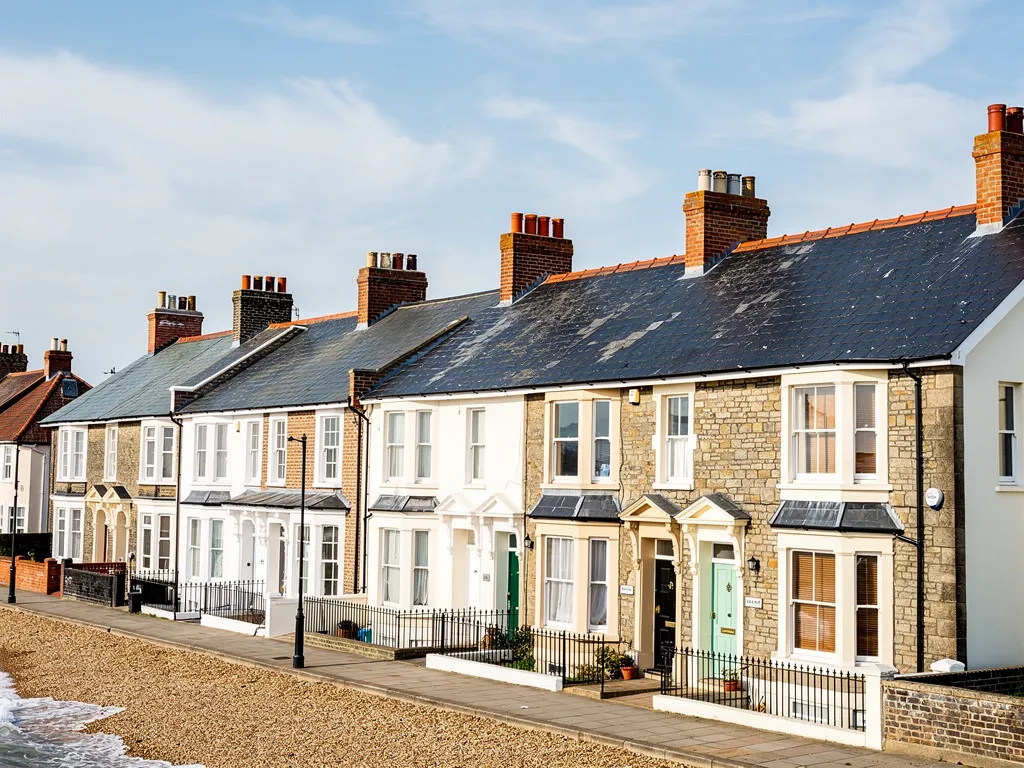
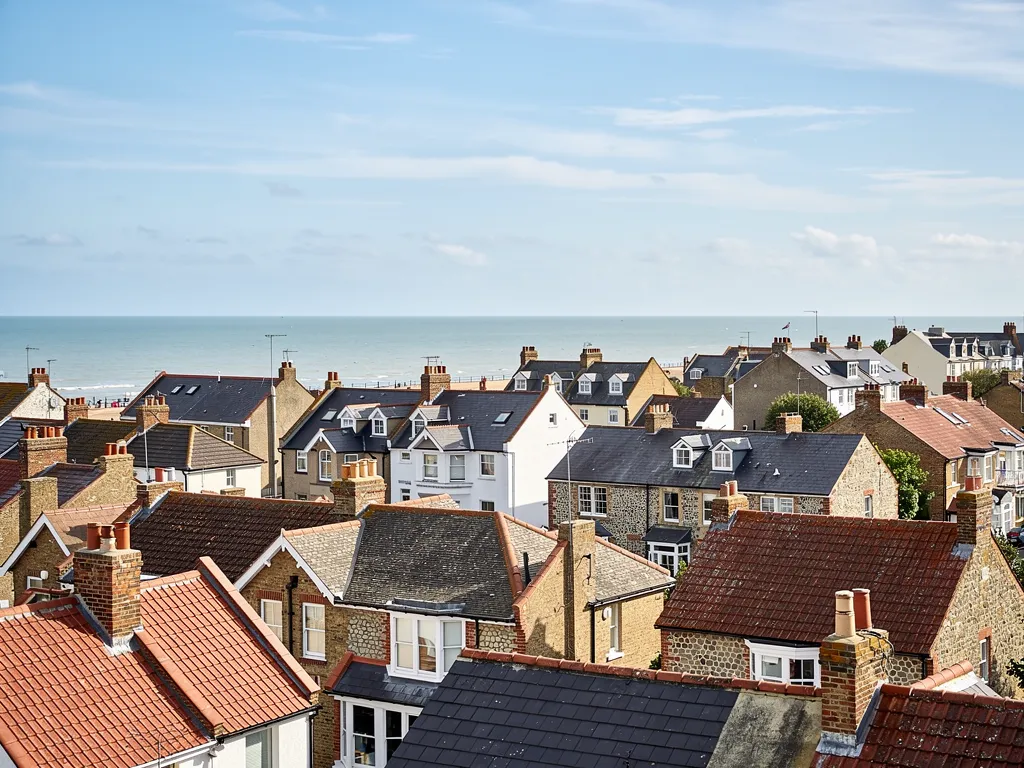
Victorian slate terrace close to the Worthing seafront with chimneys and bay windows

5.2 The twice-yearly check

Most flat roofs need little, and that little matters. Twice a year, in spring and after leaf fall, clear leaves, moss and debris from the surface, the outlets and the gutter. Look from an upstairs window, from a ladder if you are confident with one, or with binoculars at the edges, laps and upturns. Do not walk on a roof that was not built to be walked on. Watch for new puddles, lifted seams, cracked sealant and plants taking root, and take a dated photograph each time. Fixing a split in April costs less than fixing the damp it causes by February.

A flat roof check in four moves

  1. Clear Brush leaves and moss off the surface and lift them out of the outlets and gutter.
  2. Look Check laps, upturns and edge trims for lifting, splits and open joints.
  3. Photograph Take a dated picture of each edge and any puddle, from the same spot each time.
  4. Report Send us the photographs if anything has changed since the last check.
Victorian slate terrace close to the Worthing seafront with chimneys and bay windows

A survey with photographs of your own roof, including close-ups of the edges, gives you a baseline to compare against. MyBuilder puts a roof inspection at £150 to £500 and a drone survey at £200 to £400. Roof work can disturb bats and nesting birds, both protected, so we look before lifting edge or eaves trims.

New grey GRP fibreglass flat roof on a rear kitchen extension

Chapter six

What a flat roof costs and comparing quotes

National guides give a useful range for each covering; access, the deck and the insulation decide where your own roof sits.

MyBuilder's flat roof guide puts a typical complete job at £2,800 to £7,500, averaging £75 per m², and also quotes £45 to £100 per m². Per m², it gives torch-on felt at £70 to £100, EPDM at £90 to £130, GRP at £95 to £150 and lead at £150 to £200 or more. Those are national figures, not ours. They show how the coverings compare and where a flat roof cost is likely to land. Your own figure arrives in writing after the survey, as a single total, and the prices we set are good and fair.

At a glance

  • MyBuilder puts a typical complete job at £2,800 to £7,500
  • A highway scaffold needs its own licence
  • Ask whether each quote includes VAT and scaffolding

6.1 What moves the figure

Roof area comes first, but it is not the only factor. Access matters: a single-storey extension can often be worked from a ladder or a low tower, while a roof above a two-storey house needs scaffolding, which MyBuilder puts at around £850 to £1,200 for a standard two-storey set-up. If the poles and boards stand over a pavement or road, the scaffold firm applies to West Sussex County Council for a licence and the council wants at least 10 working days' notice; Brighton and Hove issues its own. Then there is what lies underneath: a rotten deck, wet insulation, awkward upstands, rooflights, several outlets or a deep parapet each add work, and so does the thickness of insulation Part L calls for. Our flat roof cost guide goes deeper.

6.2 Comparing quotes fairly

Put identical questions to each firm. Is VAT in the figure, given by GOV.UK as 20% at the standard rate? Are scaffolding and any licence covered? Is the old covering carted away and the waste disposed of properly? Will someone inspect the deck once the old roof is off, and what happens if boards are rotten? Which membrane, and which fixing method? A price set after climbing onto the roof tells you more than a lower one called out from the drive. A contract signed at your home normally carries a 14-day cancellation period. Photographs of the finished upstands, outlets and edge trims come back to you with the paperwork, and whatever guarantee any roofer offers should arrive in writing too.

Typical UK flat roof coverings, per m²

  • Torch-on felt£70 to £100 per m²
  • EPDM rubber£90 to £130 per m²
  • GRP fibreglass£95 to £150 per m²
  • PVC single ply£95 to £140 per m²
  • Lead£150 to £200+ per m²

Typical national figures from a single guide, not our prices; your written quote follows the survey. Source: MyBuilder flat roof cost guide, updated 21/08/2026.

The honest price of a flat roof appears once someone has stood on it.

Landlords and commercial owners get the same survey on a flat-roofed unit, shop or block. A bigger roof brings an access plan, edge protection and more outlets to check, and sometimes a different membrane suits it better than the one on a house. The materials guide and our commercial roofing work are the next stops there.

Flat roofing questions from Worthing homeowners

What does a new flat roof cost on a Worthing extension or garage?

MyBuilder's national guide puts a typical complete flat roof at £2,800 to £7,500, averaging £75 per m², and a flat roof section on a semi-detached house at £2,500 to £6,000. Per m² it gives felt at £70 to £100, EPDM at £90 to £130 and GRP at £95 to £150. Size, access, the state of the deck and the insulation needed move your own figure, so the exact figure comes in writing as a single sum after the survey.

How do I tell a careful flat roofer from a dodgy one?

Treat a door-knocker after a storm, a demand for cash up front or a price given without a look at the roof as warning signs. A roofing specialist worth hiring, and an experienced flat roofer in particular, gets onto the roof, checks the deck and the falls, photographs the findings, names the membrane and its fixing method, and puts one price in writing with VAT and scaffolding stated. Ask who will do the work and where you can reach them afterwards.

Which flat roof covering costs least, and is it the right choice?

On MyBuilder's figures torch-on felt has the lowest range, £70 to £100 per m², against £90 to £130 for EPDM and £95 to £150 for GRP, though the ranges overlap. Less puts felt at 10 to 20 years, EPDM at 20 to 30 and GRP at 25 to 40, so a lower price buys a shorter published life. The right choice depends on the roof's shape, its deck and how it is used. We recommend the covering that fits the roof in front of us and show you why.

Does a flat roof change how my home insurance treats a leak?

Policies differ, so tell your insurer about the flat roof and read the exclusions before you need to claim. The Financial Ombudsman Service says exclusions often cover damage that has happened gradually, and Which? cites water getting in through a roof nobody maintained as wear and tear. Storm damage is judged on the storm and its effect. Keep dated photographs and maintenance records. Our survey photographs show the cause and the condition of the covering, which is useful to have.

How long will a flat roof last near the sea?

MyBuilder says a flat roof typically lasts between 15 and 30 years. By covering, Less gives felt as 10 to 20 years and GRP as 25 to 40, and GreenSpec gives EPDM as 20 to 30. These are typical ranges, never promises. The sea air and gales make edge details, outlets and regular checks matter more, because the weakest detail is what the weather finds, so a well-detailed and well-kept roof reaches the upper end of its range.

What happens first when a flat roof is leaking into the house?

Leaks and storm damage get priority from us, and the first job is to make the roof safe. Move belongings clear, put a bowl under the drip, keep away from a bulging ceiling and stay off the roof. Call 01903 299063 or send photos by WhatsApp. We then trace the cause before any permanent repair, because the stain is often some distance from the fault, and you see photographs of what we find.

Guides to flat roof materials, costs and design

Deeper guides on EPDM, GRP and felt, falls, insulation and cost, written for Worthing extensions, garages, dormers and seafront blocks between Littlehampton and Brighton.

Guides

Quick answers

Tell us about your roof

Describe what is happening and we will call you back to arrange a visit.

  • Photographs of what we find
  • A written quote with one total price
  • Or call 01903 299063
Call Get a quote