Some roofs are worth mending again and again. Others reach a point where each repair buys a few months and the next fault is already forming a few courses along. The skill lies in telling the two apart before money goes into the wrong one.
Four questions do most of the work. How old is the covering, and what is it made of? Is the fault confined to one spot or spread across a slope? What have repairs cost over the last few years, set beside the price of a new covering? And would the work you are weighing cross the line where the Building Regulations begin to apply? None of them decides the matter alone, but together they usually leave one answer standing.
This guide takes each question in turn, then explains how a survey settles whatever is left. Our recommendation is always whichever job cures the cause with the least work, so sometimes the answer is a repair, and you get it in writing with pictures from your own loft and slopes beside it. When the answer is a new roof, those same pictures show why. If you already suspect the worst, the signs your roof needs replacing are worth reading alongside this, and our roof replacement page covers the work itself.
Age is a clue, not a verdict
Age sets expectations and nothing more. Lifespans in the published guides are ranges, not promises, and they shift with how exposed the site is, how well the roof was laid and how it has been kept. MyBuilder quotes a well-installed slate roof at 80 to 100 years or more. For clay tiles, Marley cites a minimum life expectancy of 60 years, against 30 to 60 years often given for concrete. MyBuilder gives 15 to 30 years for flat roofs in general (updated 21/08/2026), with felt towards the short end and lead and well-laid EPDM, the rubber membrane used on flat roofs, towards the long end.
Read those figures against the roof above your head. A 1930s semi under its original clay tiles may be inside or past the range for the material, so every repair there is really a question about the fixings and underlay beneath the tiles. A post-war concrete-tile bungalow with a slipped ridge is another case: the covering may have decades left and the fault sits in one detail. A felt flat roof on an extension that has reached the top of its range is a different conversation again.
Where age misleads
Old does not mean finished. Slates and good clay tiles often stay sound long after the nails and underlay beneath them have tired, and a roof can be stripped and relaid with the same covering when the timbers are healthy. Equally, a young roof can fail early if it was laid on too shallow a pitch or fixed lightly for an exposed site. A sea gale tests every shortcut, which is why we look at condition first and the date second.
If you do not know how old your roof is, the loft usually tells you. Underlay type, batten condition and the state of the nail points all show what the covering has been through since it went on.
How far the damage has spread
A single cause is a repair job. A pattern is not. When a roof has lost two tiles in a gale, or the lead at one chimney has lifted, the rest of the slope is usually doing its job and a repair closes the fault for good. The picture changes when the same problem turns up in several places, because that says the materials, not an accident, are the issue.
On a survey we look for the signs that failure is general. Tiles slipping across a whole slope point to fixings that have let go. Underlay that has turned brittle or torn in the loft means the second line of defence is gone beneath the entire slope. Battens are the small timber strips fixed across the rafters to hang the covering from, and where they feel soft or snap when probed, the structure under the covering needs attention as well. Slates that flake apart in layers, and tiles whose faces crumble, a fault called spalling, are covering failure rather than damage. None of that can be cured one tile at a time.
Why patching can make matters worse
Lifting sound tiles to reach one fault risks cracking the neighbours, and old tiles that have bedded together rarely go back as they came out. Where the covering is brittle, a repair can cost nearly as much in breakages as the fault itself did. That is often the moment to stop patching.
Extent also shapes the proposal. If a single slope has gone while its neighbours are healthy, the sensible answer may be to renew that slope alone, which keeps the work and the bill smaller. The survey shows whether the other slopes will stand up to being left behind, and whether the old and new coverings can sit together without a visible join.

What repeated repairs add up to
One repair is easy to justify. The fifth in four years rarely is, yet each one feels small on the day. The way to see it clearly is to add up what you have spent, add the quote now in front of you, and set the total beside the cost of a new covering. Dig out the old invoices if you have them. People are often surprised by the sum.
Typical UK ranges give a rough frame. MyBuilder (updated 21/08/2026) puts a roof repair at £150 to £1,500, with moderate repairs at £500 to £1,000 and major ones at £2,500 or more. The same guide puts a whole new roof for a house at £5,000 to £12,000.
| Job | Typical UK range |
|---|---|
| Moderate roof repair | £500 to £1,000 |
| Major roof repair | £2,500 or more |
| Re-bedding or replacing ridge tiles | £300 to £600 |
| Re-roof, semi-detached, gable | £5,000 to £8,000 |
| Re-roof, semi-detached, hipped | £8,000 to £12,000 |
Figures from MyBuilder, updated 21/08/2026. They are national guides, not our prices.
Scaffolding sits quietly behind this arithmetic. MyBuilder gives £850 to £1,200 for scaffolding a two-storey house, and any repair that needs a tower or a full scaffold pays for it again each time. Repeat visits to the same slope can overtake a single, properly planned job. Our guide to what a new roof costs shows what moves the price either way.
When you compare a repair quote with a replacement quote, check whether each includes VAT and scaffolding. Price follows the access, the covering chosen, the area to be covered and whatever the loft inspection reveals. Our written quote lands as one total sum, priced fairly.
The 50 per cent line in the Building Regulations
There is a legal side to this choice, and it is easy to get wrong. According to the Planning Portal, a building control application is normally unnecessary for repairs or re-covering when work touches under 25 per cent of the total building envelope and under 50 per cent of the roof. The envelope means the walls, floor, roof, windows, doors and roof windows added together. Pass either figure, change the structure, or or lay a covering at least 15 per cent heavier, and approval is needed.
Approved Document L, the energy rules for dwellings, adds the thermal side. Its test is more than 50% of the roof surface being renovated, and then the whole roof element may need upgrading to the standard set for existing buildings. A major renovation, meaning more than 25% of the external envelope, has the same effect. In practice a full re-roof usually crosses the line, while a few courses of tiles, a ridge or one small slope normally does not.
That is why the decision reaches beyond price. A larger replacement may bring insulation work with it, and a notification to your registered building control approver or the council. We explain consent and then submit the Building Regulations notification for any job that needs one, and our page on what happens during a roof replacement shows where that fits in the sequence.
Check which side of the line you are on before agreeing a scope. A repair that quietly grows to cover most of a roof can end up needing the paperwork a replacement would have had.
Planning is a separate matter. Putting back a matching covering rarely needs planning consent, yet a listed building, or a conservation area with an Article 4 direction, can alter that. If your street is in one, put the question to the Adur & Worthing planning team first.
Mending one slope or renewing the lot
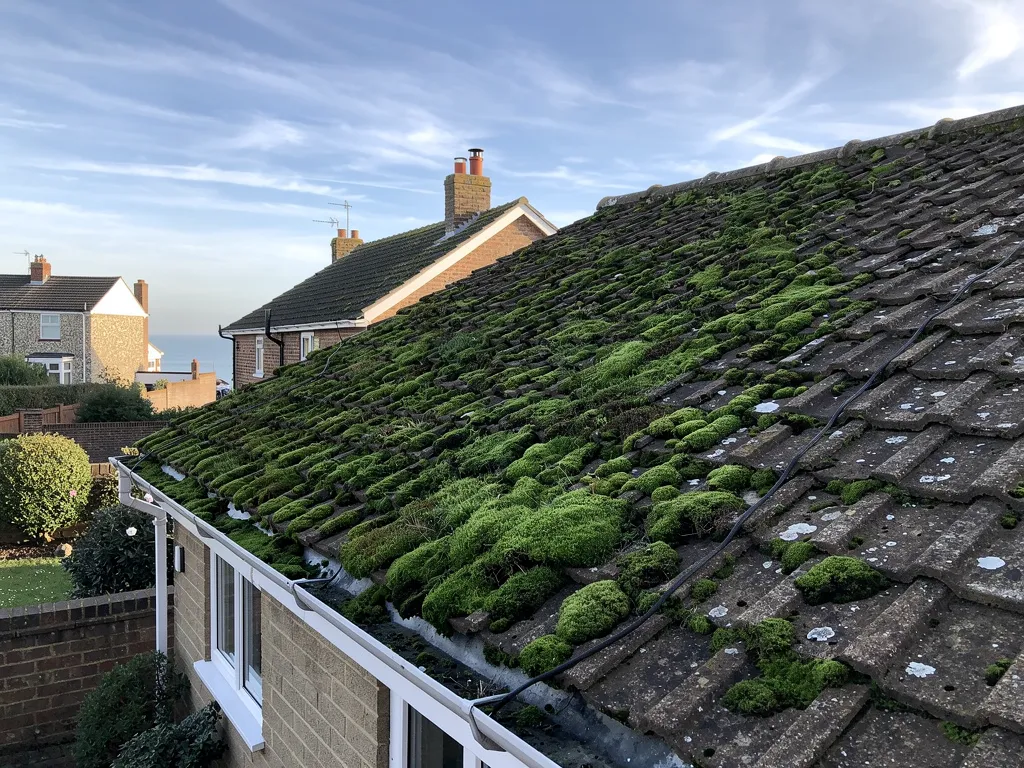
The choice is rarely all or nothing. Many roofs sit in between, with one failing slope, a tired valley or a rear extension that has outlived the main roof. A good survey tells you where the line falls.
Renewing one slope makes sense when it is clearly worse than the rest, perhaps because it carries the heaviest weather off the sea, and the others have years in them. It needs a clean break at a ridge or a valley, covering that can be matched, and timbers able to take the extra work. The drawback is that you pay for scaffolding once now and probably again when the rest follows, so it suits only a roof where the other slopes genuinely have time left.
Renewing everything is the better course when failure is general: underlay perished throughout, battens soft, fixings gone, or covering crumbling or delaminating on every side. It also wins when you plan other work, such as a loft conversion, solar panels or a new chimney, that is better done on a fresh roof than an old one.
A repair is the right answer more often than people fear
If a lead valley has split, a ridge has lost its fixings or a hip has slipped, the roof around it is often sound, and a precise repair is the better job. A mechanically fixed ridge and verge, or a properly dressed flashing, can hold for years. Replacing a roof to cure a fault that sits in one detail would be the wrong job, and we tell you so.
Where a repair is clearly the right answer, our roof repairs page shows what that involves, and a repair completed properly is worth far more than a replacement you did not need.
How the survey settles it
Opinions about a roof differ from roofer to roofer, and your own judgement has to work from the stain on a ceiling. A survey replaces both with evidence. We go into the loft, follow any water back to where it started, and then check the outside: the covering, the ridge and hips, the valleys, the flashings and the gutters. We photograph what is wrong on your roof, and those photographs come with a written quote.
That evidence answers the four questions in this guide. Age and material give the likely remaining life. Photographs of the underlay and battens show how far the damage reaches. A repair quote set beside a quote to renew shows whether repeated repairs have started to lose. The extent of the work shows where the Building Regulations thresholds land.
Because the cause is found before any price is given, you are not asked to choose between a vague repair and a vague replacement. You see the two options laid out against your own roof. If a repair properly fixes the problem, that is what we propose, and if it does not, the pictures explain why.
Whichever route you choose, ask what written cover comes with it. A manufacturer's warranty on tiles is a separate document, and it forecasts nothing about how many years the roof has left.
Whichever way it goes, nothing is left behind: rubbish is carted off and the ground is swept.
If you are still unsure, send us the age of the house, a few photographs from the ground and any earlier invoices, and tell us where the water has shown. The survey itself gives the firm answer.